D2C Growth Agency UK: How to Choose the Right Partner for Profitable Scale
More channels won’t fix a growth constraint you haven’t diagnosed. When assessing a D2C growth agency UK brands can rely on, start with a harder question: what is actually limiting profitable scale? If conversion is weak or repeat purchases are slipping, adding acquisition spend may amplify the prob...

More channels won’t fix a growth constraint you haven’t diagnosed. When assessing a D2C growth agency UK brands can rely on, start with a harder question: what is actually limiting profitable scale? If conversion is weak or repeat purchases are slipping, adding acquisition spend may amplify the problem rather than solve it.
Agency service pages often list the same channels, but a channel list rarely shows how paid activity, the website and CRM work together. It can also be difficult to tell who will lead the account, what they’ll own and how performance will be judged. Those details matter as much as the service menu.
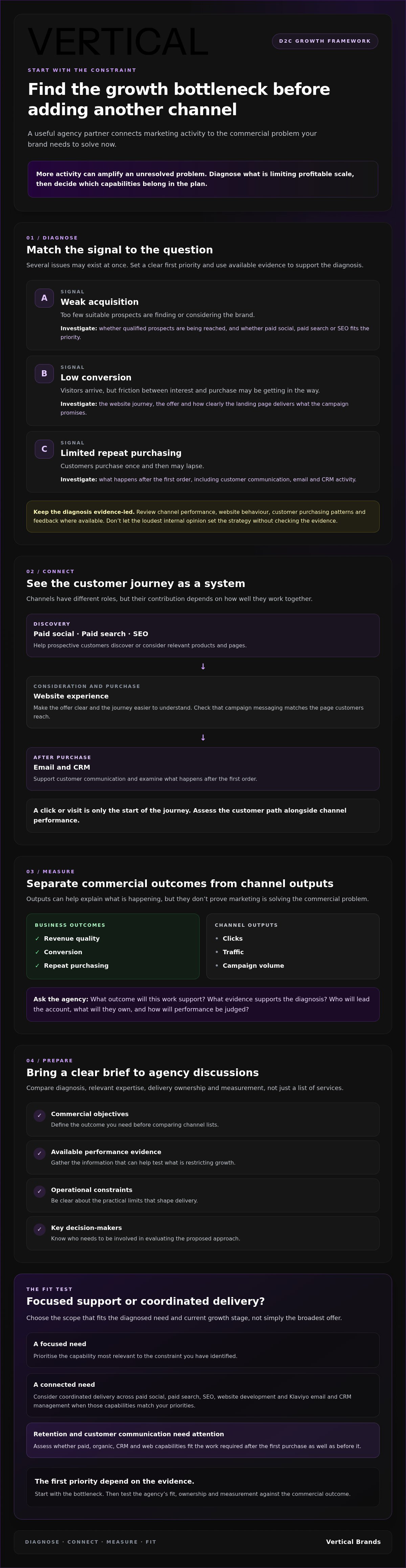
This guide gives you a practical framework to identify the constraint an agency should address first, then compare its capabilities, accountability and measurement against your commercial priorities. You’ll learn how to assess whether you need focused support or coordinated delivery across paid social, paid search, SEO, website development and Klaviyo email and CRM management. The aim is to find a partner whose work fits your current needs and growth stage, not simply the broadest offer. Start with the bottleneck, then test the fit.
• Define the commercial outcome you need before comparing agency channel lists. The right priority depends on what is restricting growth now.
• Assess how acquisition, website experience and CRM activity support one another, rather than treating each channel in isolation.
• Compare a D2C growth agency UK on its diagnosis, relevant expertise, delivery ownership and approach to measurement.
• Prepare your objectives, available performance evidence, operational constraints and key decision-makers before agency discussions.
• Consider whether Vertical Brands’ paid, organic, CRM and web capabilities fit your current needs, particularly if retention and customer communication need attention.
What should a D2C growth agency UK partner actually solve?
A D2C growth agency is a partner that aligns marketing activity with a brand’s commercial priorities. A useful brief starts with the business outcome, not a request to add another channel. A Direct-to-consumer (D2C) business model means selling directly to customers, giving the brand a direct relationship with its buyers. An agency’s role is to help address the specific constraint affecting that model, not to assume every brand needs the same mix of services.
Separate outcomes from outputs. Revenue quality, conversion and repeat purchasing are business outcomes. Clicks, traffic and campaign volume are channel outputs. Outputs can help explain what is happening, but they don’t prove that marketing is solving the commercial problem. A D2C growth agency UK partner should connect its proposed activity to the outcome your brand needs to improve.
For a useful introduction to D2C, watch this video:
Which growth constraint should an agency address first?
Start by distinguishing the symptom. Weak acquisition means too few suitable prospects are finding or considering the brand. Low conversion points to friction between interest and purchase, which could involve the website experience or the offer. Limited repeat purchasing suggests the brand may need to examine what happens after the first order, including customer communication and retention activity.
Use business evidence to test the diagnosis. Review channel performance, website behaviour, customer purchasing patterns and feedback where available. Don’t let the loudest internal opinion become the strategy without checking what the evidence supports. Several issues can exist at once, but the brief still needs a clear priority and a reason for addressing it first.
Why more marketing activity may not fix the problem
Adding channels can increase activity without resolving the constraint. If a website makes product choice or checkout difficult, more paid traffic may send additional visitors into the same friction. If the offer doesn’t meet customer expectations, stronger campaign reach alone may not change the decision to buy.
Retention matters too. If customers aren’t returning, increasing acquisition may keep bringing in first-time buyers without addressing what happens after purchase. Review your own data before commissioning more activity. These signals point to different possible causes, so ask an agency to explain its diagnosis, the evidence behind it and why its proposed first move fits your commercial priority.
How an integrated D2C growth agency connects channels to commercial goals
Channel coordination should follow the priority you’ve identified, not a standard package applied to every brand. If the constraint is attracting qualified prospects, paid social, paid search or search engine optimisation may have a role. If visitors arrive but don’t buy, the website journey may need attention. If customers purchase once and then lapse, email and CRM activity could be more relevant. The right mix depends on the commercial goal and what the evidence says.
The UK market context matters, but it doesn’t dictate a channel plan. The International Trade Administration’s guide to the UK's digital economy offers a useful reference for brands assessing their market. Strategy still needs to be grounded in your own customers, offer and performance data.
Where paid media, SEO and website experience meet
Paid social and paid search can bring prospective customers to a product or category page. SEO can help people discover relevant pages through organic search. Each channel has a different role and needs measures suited to that role. But a click or visit is only the start of the journey. If an advert promises something the landing page doesn’t clearly deliver, or the page makes it hard to understand the offer, campaign traffic may be less valuable.
Connect campaign messaging to the page customers reach, then review the journey alongside channel performance. This helps distinguish an acquisition issue from a website experience problem. Brands reviewing paid social delivery can also use a focused paid social management resource to explore that channel’s role in more depth.
How CRM and email support customer retention
CRM and email can help a brand communicate with customers after the first interaction or purchase. Customer data can inform relevant lifecycle messages, while campaign and website insights can help shape what those messages address. Retention activity complements acquisition; it doesn’t remove the need to attract new customers. If a platform change is part of the plan, a Klaviyo migration guide may help frame the transition questions to resolve.
Integration needs clear operating rules. Agree the shared commercial objective, define who owns each channel and hand-off, and establish what gets reported and when. Gaps often emerge at hand-offs, so make responsibilities explicit. A useful report should connect channel activity to the agreed goal while showing the measures each channel owner uses to assess progress.
Brands that need coordinated delivery across paid, organic, CRM and web can review Vertical Brands’ growth capabilities against their diagnosed priority and team requirements.
How to compare D2C growth agencies beyond their service lists
A long service list tells you what an agency could deliver, not whether it can solve your current challenge. Compare each D2C growth agency UK against the same criteria. Ask for specific evidence, named delivery owners and a measurement approach tied to your objective.
Use this framework to structure conversations and record what each agency can substantiate:
| Area | What to assess | Question to ask |
|---|---|---|
| Diagnosis | How the agency identifies the business constraint and prioritises its response. | What evidence would you review before recommending a plan? |
| Relevant expertise | Experience addressing a challenge similar to yours, not simply working in a similar sector. | Can you show an example with a comparable business model and constraint? |
| Delivery ownership | Who leads strategy, carries out the work and coordinates with your team or suppliers. | Who will manage the work day to day, and what sits outside your scope? |
| Measurement | How progress will be reported against the agreed commercial objective. | Which measures will you track, and how will they inform decisions? |
What evidence should a D2C agency provide?
Request a case study that explains the starting problem, the work delivered and the outcome reported. Check whether the example resembles your business model and immediate constraint. A brand’s growth challenge may differ even when it sells similar products or uses the same channels.
Separate evidence from assertion. A testimonial or headline result can provide context, but ask how the outcome was measured, what work contributed and what other factors may have influenced it. Past results don’t guarantee future performance. A strong case study explains its limits as well as its findings.
How to assess team fit and accountability
Ask who leads strategy, manages execution and communicates progress. Confirm which tasks belong to the agency, your internal team and any existing suppliers. This matters when paid activity, website work and CRM need coordination. If ownership is vague, gaps or duplicated effort can follow.
Before appointment, compare reporting practices, decision-making cadence and escalation routes. Ask what information you’ll receive, who reviews it with you and how the team responds when performance differs from plan. The answers should make accountability visible, not leave it to assumption.
Record each agency’s responses against the same criteria. That makes it easier to distinguish a relevant partner from a persuasive pitch and identify where further clarification is needed before you decide.
What to prepare before appointing a D2C growth agency in the UK
A focused brief gives a prospective D2C growth agency UK a better basis for assessing fit. It also helps you compare recommendations on substance, rather than the confidence of the pitch. Prepare the information below before your first discussion. It doesn’t need to be a perfect data pack, but it should make clear what you know, what you suspect and what you need to decide.
Build a brief around the business problem
State the commercial objective.
Describe the business outcome you want to address, such as improving conversion or encouraging more repeat purchasing. Explain what prompted the agency search and why this priority matters now.
Summarise current evidence.
Document channel performance and relevant website or customer patterns you already track. Include the period covered and any known gaps in the information. Don’t invent thresholds or treat incomplete data as a firm diagnosis.
Map your operating set-up.
List active channels, internal capabilities, existing suppliers and known dependencies. Note constraints that could affect delivery, such as approval processes, website changes or access to customer information.
Separate facts from assumptions.
Mark what you have verified and what remains a working theory. For example, “repeat purchasing appears limited” is an assumption until your customer data supports it. Ask the agency how it would test that view.
Name the decision-makers.
Identify who owns the commercial objective, who will work with the agency and who approves priorities or changes. This prevents important decisions from being delayed or left without an owner.
If your immediate need sits within a broader scaling question, use an e-commerce growth stages framework to consider what your business is ready to address. Treat it as context for the conversation, not a substitute for reviewing your own evidence.
Agree how progress and decisions will be managed
Before discussing detailed execution, ask agencies to explain their proposed priorities, responsibilities and measurement approach. Define which measures relate to your objective, how progress will be reported and who will review it. Avoid setting targets without a clear basis in your business data.
Agree how often you’ll communicate, who can make decisions and how issues will be escalated. The first conversation should test the agency’s diagnosis: does it ask useful questions, identify missing evidence and explain how it would prioritise the work? A polished presentation alone can’t show whether the proposed approach fits your constraints.
Bring this brief to a discussion with Vertical Brands about your growth priorities. Its capabilities span paid, organic, CRM and web, so assess the fit against your stated objective, team and delivery requirements.
When Vertical Brands could fit your D2C growth priorities
Vertical Brands is an independent UK growth consultancy with capabilities across paid media, organic search, CRM and website development. Its offer may suit a brand whose diagnosed need spans connected growth levers, rather than one isolated channel. That breadth isn’t a reason to use every service. The right scope depends on the business problem, existing team and work already handled by other partners.
Which business needs align with Vertical Brands’ services?
Match the service to the constraint you need to address. For example:
Acquisition
Paid social and paid search may fit where the priority is reaching prospective customers through paid channels.
Organic visibility
Search engine optimisation may be relevant when improving discovery through organic search aligns with the objective.
Retention and lifecycle communication
Klaviyo email marketing and email marketing and CRM management are relevant when customer communication after initial engagement or purchase needs attention.
Website experience
Website design and development may fit when the site itself is part of the identified challenge.
Vertical Brands also offers growth advisory, influencer marketing and UGC content. Whether any of these belongs in your plan depends on the brief, internal capability and existing supplier responsibilities. A brand with a clear, narrow requirement may need a specialist for that requirement. A broader service mix can be useful where the diagnosed priority calls for coordinated delivery across channels.
For a brand comparing a D2C growth agency UK partner, the practical test is fit: can the proposed work address the constraint, and are ownership and measurement clear? You shouldn’t need to adopt a full service mix simply because it’s available.
What to cover in an initial growth conversation
Bring a concise account of your objectives, the evidence behind them, current channels and partners, and any delivery constraints. Explain what your team can manage and where support may be needed. Separate established facts from assumptions so the discussion can test the diagnosis before settling on activity.
Use the conversation to clarify priorities and responsibilities. Ask how the proposed services connect to your objective, who would own the work and how progress would be assessed. The initial discussion should establish whether the consultancy’s capabilities match your needs, not presume that every channel is required.
If the fit looks relevant, Discuss your D2C growth priorities with Vertical Brands. Share the business constraint you want to address and the evidence you have. Then assess together whether its capabilities align with your priorities.
Choose your next growth move with confidence
The right agency decision starts with the constraint holding back profitable scale, not the longest service list. Identify the business priority, check it against available evidence and decide what needs attention first. Acquisition, conversion and retention call for different responses.
Then compare partners on how they diagnose the issue, who will own delivery and how progress will be measured. Your objectives, evidence and known constraints give an agency a clearer basis for recommending where to focus. Look for capabilities that match the brief, not activity for its own sake.
Vertical Brands offers paid social, paid search, SEO and web development, alongside Klaviyo email marketing and CRM management. These capabilities may suit brands whose diagnosed needs span acquisition, website experience and customer communication. The right combination depends on your priorities and existing team.
Ready to test the fit? Discuss your D2C growth priorities with Vertical Brands. Bring your objectives, current evidence and delivery constraints to the conversation. A clear brief is a practical first step towards choosing a partner aligned with your commercial goals.
Frequently Asked Questions
What does a D2C growth agency do?
A D2C growth agency helps a direct-to-consumer brand align digital marketing activity with commercial priorities. It may advise on or manage services such as paid social, paid search, SEO, website development, and email and CRM management. The aim is to address a defined business constraint, not simply increase clicks or campaign volume. The appropriate scope depends on the brand’s objectives, evidence, internal capabilities and existing partners.
How do I choose a D2C growth agency in the UK?
Choose a D2C growth agency UK partner by first identifying the business issue it needs to address. Review your channel performance and other relevant evidence, then compare agencies on their diagnosis, relevant expertise, delivery ownership and measurement approach. Ask for examples tied to a similar challenge, and clarify who will manage the work and how progress will be reported. Past results can inform your assessment, but don’t guarantee future performance.
Is a full-service D2C agency better than a specialist agency?
Neither is automatically better. A specialist may suit a focused need, such as paid search management or CRM support. A broader agency may be a better fit if your priority spans connected channels and you want coordinated delivery. Compare both against the diagnosed constraint, your team’s capabilities and existing supplier responsibilities. Don’t pay for breadth you don’t need, and check that the people delivering the work have relevant experience.
Can a D2C growth agency manage paid media and customer retention together?
Yes, if the agency offers both capabilities and can define how they support the same commercial objective. Paid social or paid search can support customer acquisition, whilst email and CRM management can support communication with existing customers. If you want to see how an agency creates integrated communication systems geared around commercial performance, check out The Palm Group. Ask how teams will share insights, assign ownership and report on each channel’s contribution. Paid media and retention activity work best when the roles are clear, rather than managed as disconnected tasks.
How much does a D2C growth agency cost in the UK?
There isn’t one standard fee that applies to every D2C growth agency engagement. The proposed scope, services required, level of delivery ownership and coordination with your team can all affect a quote. Ask each agency to set out what its fee covers, what falls outside the agreed work and whether any additional costs may apply. Compare proposals against your priorities and available budget, not just the headline figure.
What should I ask a D2C marketing agency before hiring it?
Ask how the agency would diagnose your growth constraint and what evidence it needs before recommending activity. Clarify who will lead strategy, manage delivery and report progress, plus how it will work with your team and existing suppliers. Ask for a relevant case study that explains the starting challenge, work delivered and reported outcome. Also agree which measures matter, how often you’ll review them and how decisions or issues will be handled.
How can I tell whether my D2C brand is ready to work with an agency?
Your brand may be ready if you can state the commercial objective, share relevant evidence and identify who will make decisions and work with the agency. You don’t need perfect data, but you should be able to explain what’s known, what’s assumed and where delivery constraints exist. If the priority is unclear, start by organising those details. A clear objective and named decision-makers help make an agency conversation more productive.

Other posts































































Stay ahead with better decisions.
Get business insights today.
