D2C Website Development: The Technical Architecture for High-Growth Brands in 2026
Your storefront is not a digital brochure; it is an unforgiving transactional engine. In the competitive arena of D2C website development London operators frequently discover that creative polish means nothing if core infrastructure buckles under real commercial volume. You already recognise the com...

Your storefront is not a digital brochure; it is an unforgiving transactional engine. In the competitive arena of D2C website development London operators frequently discover that creative polish means nothing if core infrastructure buckles under real commercial volume. You already recognise the compounding drag of escalating acquisition costs, bloated theme code, and leaky checkout funnels that quietly suppress conversion rates across every channel.
Too often, a fragmented tech stack between storefronts and retention systems fail to synchronise behavioural signals, draining customer lifetime value before ad spend ever breaks even. It is time to engineer real efficiency. This guide details how to master the technical, UX, and retention infrastructure required to turn your D2C e-commerce website into a high-velocity conversion engine. We examine the exact development frameworks, sub-second performance thresholds, and Klaviyo synchronisations required to drive sustainable scale across the UK in 2026.
Key Takeaways
• Strategic D2C website development London benchmarks prove that treating your storefront as a transactional engine is vital for lowering customer acquisition costs.
• Platform selection dictates your technical ceiling; evaluate whether Shopify Plus or composable architecture align best with your long-term operational scale.
• Sub-second load times and rigorous Core Web Vitals compliance are non-negotiable engineering standards to eliminate costly checkout drop-offs.
• Server-side tracking combined with seamless Klaviyo CRM integration ensure clean first-party data directly drives higher customer lifetime value.
• Vetting engineering partners on verifiable code audits rather than static design mockups protects your commercial margins from technical debt.
The Architectural Foundations of Modern D2C Website Development
Storefronts are conversion engines, not interactive art portfolios. In modern commercial execution, the Direct-to-consumer (D2C) business model relies on frictionless transactional infrastructure. Traditional agencies sell visual polish. They miss the commercial point entirely. When evaluating criteria for D2C website development London operators often audit aesthetic flair whilst ignoring backend latency. Every millisecond of rendering delay directly inflates paid customer acquisition costs.
To better understand how modern architectural stacks impact speed and commercial agility, examine this structural breakdown:
High-growth brands require decoupled data layers to support comprehensive omnichannel tracking. Code efficiency determines your scalability far more than surface layout. A lean codebase maintains server responsiveness under aggressive traffic spikes, ensuring that paid campaign momentum translates directly into recorded orders.
Performance-Driven Architecture vs Traditional Storefronts
Traditional brochure sites prioritise graphic flair over core transactional velocity. That model collapses under aggressive media spend. Engineering for scale requires modular components, streamlined asset delivery, and strictly managed third-party scripts. Clean engineering underpins sustainable customer lifetime value, as outlined in our analysis of performance driven web design. Every line of front-end code must justify its impact on the bottom line.
The Direct Commercial Cost of Technical Debt
Accumulated plugin bloat actively suppresses mobile conversion rates and checkout completion. Many brands relies on fragmented stacks that prevent reliable first-party event tracking under evolving privacy regulations. This operational drag compounds over time. Technical debt turns routine merchandising changes into slow, expensive hurdles that bleed margin across your entire product catalogue.
Evaluating Modern D2C Platforms: Shopify Plus vs Composable Commerce
Selecting your operational foundation establishes your technical ceiling for the next three to five years. In high-growth direct retail, platform migration is major surgery on a live revenue stream. The debate surrounding D2C website development London projects typically divides into two camps: enterprise SaaS or modular composability. Both models are commercially viable. Only one will match your internal developer velocity and capital allocation strategy.
When Shopify Plus Is the Strategic Choice
Shopify Plus remains the benchmark for rapid commercial execution. Its managed cloud infrastructure absorbs extreme traffic spikes effortlessly, eliminating server provisioning risks during high-stakes sales periods. The platform's native one-page checkout delivers industry-leading completion rates out of the box. Furthermore, direct compatibility with tier-one CRM systems and acquisition channels accelerates deployment timelines. For brands demanding reliable conversion velocity without continuous infrastructure overhead, it offers compelling capital efficiency.
The Business Case for Headless and Custom Builds
Headless architecture decouples your customer-facing presentation layer from core transactional logic via high-speed APIs. This framework excels when standard templates restrict complex product customisation, bespoke subscription logic, or multi-currency internationalisation. It also allows brands to cleanly feed dynamic pricing and inventory updates across channels, strictly adhering to modern truth-in-advertising standards without performance lag. Headless builds provide absolute frontend autonomy, but they demand dedicated engineering retainers to maintain edge middleware and API integrity.
Total Cost of Ownership and Scalability Metrics
Every software architectural decision is an operational cost allocation. While composable microservices unlock design freedom, the ongoing maintenance of multi-layered composable systems require significant engineering resources. Subscription costs for headless content management, microservices, and specialized developer retainers compound rapidly. Scale demands discipline. Operators must evaluate whether bespoke architecture drives measurable customer lifetime value or simply inflates operational overhead. If your brand needs to balance technical flexibility with commercial returns, our growth advisory specialists help engineering leaders architect platforms that protect margins whilst accelerating top-line revenue.
Core Engineering Pillars: Speed, UX, and Checkout Friction
Execution beats visual presentation every time. In modern D2C website development London brands must treat front-end engineering as direct conversion rate optimisation. Speed is not a cosmetic preference. Slow websites bleed revenue. Google Core Web Vitals enforce hard operational benchmarks: Largest Contentful Paint must resolve in 2.5 seconds or less, whilst Interaction to Next Paint requires a threshold under 200 milliseconds. Missing these performance targets suppresses paid ad quality scores and drives customer bounce rates upward before intent ever forms.
Technical Speed Optimisation Beyond Basic Image Compression
Modern performance engineering requires structural rigor. Compressing hero images is simply table stakes. High-velocity storefronts deploy critical CSS extraction to paint above-the-fold views instantly, deferring non-essential scripts until initial render completes. Edge caching on modern CDNs ensures dynamic assets resolve close to the user, eliminating server round-trip latency. Continuous tag audits are equally critical; cutting orphaned tracking pixels and outdated vendor libraries protect both execution speed and user data hygiene.
Mobile Product Page and Cart Drawer Engineering
Desktop displays are secondary. Over seventy percent of paid commercial traffic lands on mobile screens, demanding strict interface discipline. Key commercial components; variant selectors, pricing tiers, and primary calls to action, must sit immediately within the thumb zone. Sticky buy buttons prevent friction as shoppers scroll through customer reviews. A slide-out cart drawer should function as an active sales driver, incorporating dynamic free-shipping progress indicators and one-click upsells. Structuring these touchpoints mirrors our proven layout principles for high converting e-commerce landing pages, ensuring intent translates smoothly into basket volume.
Checkout Velocity and Alternative Payment Mechanisms
Every additional form field reduces gross margin. Frictionless checkout experiences prioritize speed through integrated accelerated wallets.
Instant Wallets
Shop Pay, Apple Pay, and Google Pay bypass tedious address forms, cutting purchase time to seconds.
Flexible Financing
Modern Buy Now Pay Later options offer capital flexibility without cluttering the mobile viewport.
Address Autocompletion
Predictive address lookups eliminate delivery typos and speed up order completion.
These operational upgrades remove hesitation at the final gateway, transforming casual mobile traffic into confirmed orders.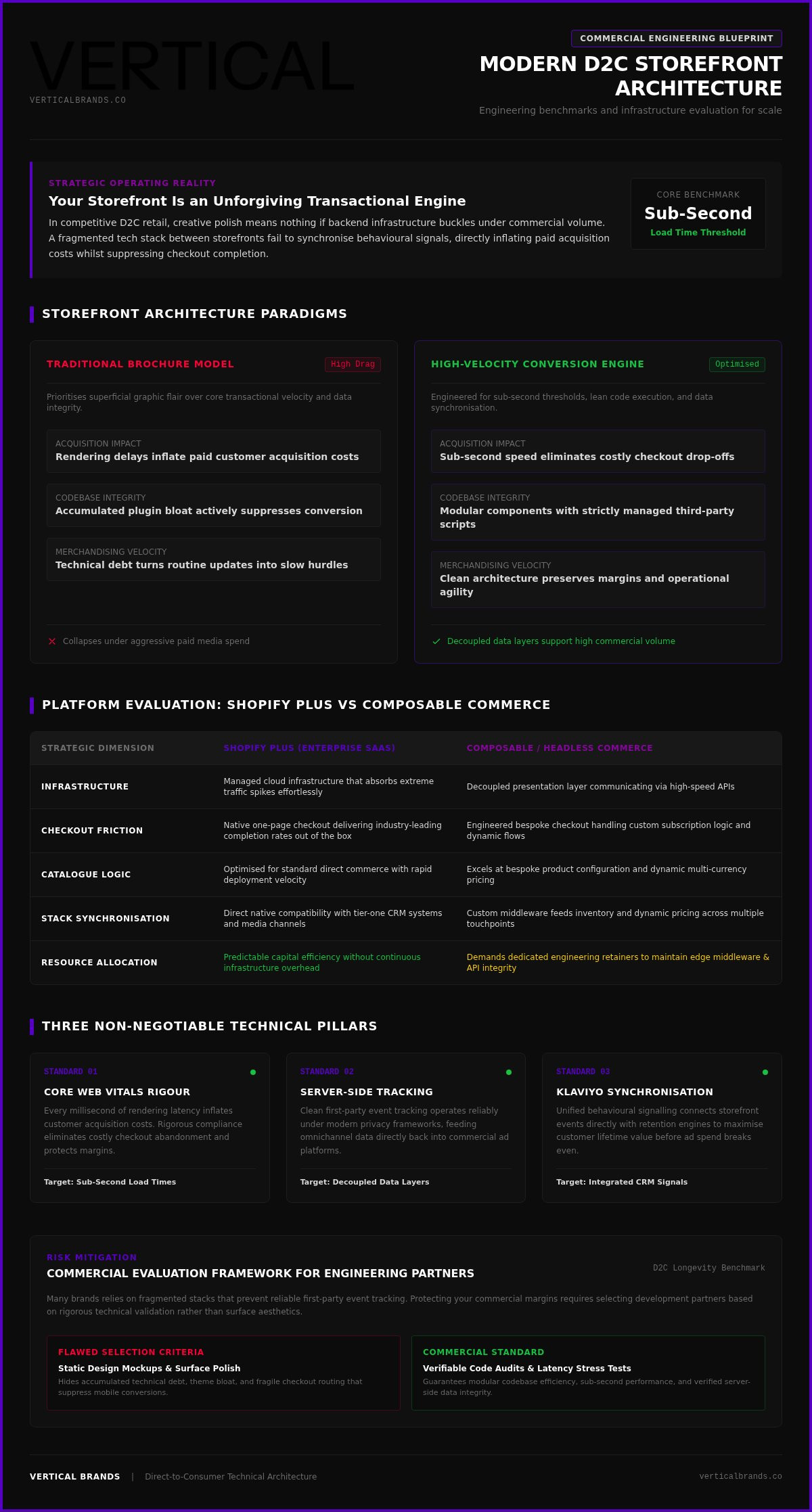
Unifying Storefront Engineering with Data Tracking and CRM Systems
A transactional storefront without unified data tracking burns paid media spend. Traditional agencies treat analytics as an afterthought, pasting script tags into the theme header and calling it a day. That approach is commercially fatal. Advanced D2C website development London requirements mandate that data pipelines are engineered straight into the site's core architecture. If your storefront fails to capture precise behavioural signals, your paid acquisition algorithms operate blind, driving acquisition costs up while suppressing repeat purchases.
First-Party Data Pipelines and Server-Side Event Tracking
Browser-based tracking pixels lose critical attribution data due to ad blockers and browser privacy restrictions. Relying solely on client-side measurement blindfolds your marketing teams. Brands must deploy server-side Google Tag Manager and direct Conversions APIs to recover dropped signals. A robust event schema captures every micro-conversion without latency:
Standardised Event Payloads
Synchronise exact product variants, cart values, and currency parameters server-to-server.
Attribution Resilience
Ensure ad platforms receive accurate purchase data even when client-side scripts are blocked.
Regulatory Alignment
Control precisely what user identifiers leave your servers under strict UK privacy laws.
These server-side pipelines turns raw traffic into predictable, compliant growth data.Deep CRM and Klaviyo Infrastructure Integration
Acquiring a customer is pointless if your infrastructure cannot retain them. Custom web development must feed real-time customer data directly into your retention stack. Custom profile properties gathered during quiz funnels, newsletter sign-ups, and checkout flows should populate your CRM instantaneously. This real-time synchronization enables predictive re-order triggers based on actual product consumption intervals. For operators planning platform shifts, our technical framework for Klaviyo migration services details how to preserve historical customer records without breaking segmentation logic.
Every dynamic on-site capture mechanism must be engineered to prevent layout shifts that hurt Core Web Vitals. Precision integration turns one-off shoppers into repeat buyers. To align your technical architecture with scalable customer retention, partner with our specialised team to scale your digital growth ecosystem today.
Selecting an Engineering Partner: The Commercial Evaluation Framework
Static mockups don't generate cashflow. Creative pitch decks won't rescue an unoptimised checkout pipeline. When evaluating proposals for D2C website development London operators must demand strict commercial accountability. Your engineering partner must speak the language of unit economics, net margins, and transactional velocity. If an agency cannot articulate how their code structure impacts your return on ad spend and retention cohorts, they are selling visual art, not scalable infrastructure.
Evaluating these deliverables require verifiable code audits rather than static PDF wireframes. High-growth brands need technical specialists who understand how storefront performance dictates acquisition efficiency. Whether partnering with domestic agencies or engaging specialised remote expertise for full stack web application development Pune, establish explicit service level agreements tied directly to sub-second load times, checkout uptime, and Core Web Vitals maintenance under heavy seasonal volume.
Crucial Technical Questions to Ask Prospective Developers
Cut through agency sales rhetoric with direct technical interrogation. Require verifiable proof before committing capital:
Script Isolation
How do you sandbox third-party tracking scripts to prevent main-thread execution blocking?
API Engineering
Can you provide live examples of custom endpoints engineered to synchronise real-time inventory and CRM signals?
Deployment Governance
What continuous integration pipelines, version control standards, and automated regression testing protect production environments?
Code quality reveals operational maturity. Demand access to sanitized repositories rather than curated portfolio highlights.Aligning Commercial Retainers with Long-Term Growth
One-off transactional builds are misaligned with aggressive scaling targets. A website launch is merely day one of live commercial stress testing. Traditional agencies hand over code and disappear, leaving internal teams stranded when checkout bottlenecks emerge during aggressive paid campaigns.
Structure ongoing commercial partnerships around continuous conversion rate optimisation and proactive infrastructure monitoring. Forward-thinking partners such as PurpleCow Digital exemplify this approach by uniting strategic website design and development with continuous technical oversight to safeguard commercial performance. Prioritise technical retainers that audit speed regressions whenever your team launches new marketing initiatives. Crucially, retain absolute operational independence. Your business must maintain undisputed ownership of every code repository, deployment pipeline, and digital asset from the very start.
Architecting Your Storefront for Sustainable Scale
Scaling direct-to-consumer retail demands technical discipline. When setting standards for D2C website development London operators must prioritise transactional velocity over superficial design trends. Eliminating checkout friction, enforcing server-side tracking, and unifying your storefront with Klaviyo CRM ensures every acquisition pound delivers measurable commercial yield. The technical foundations of your digital architecture dictates whether your margins expand or dissolve under rising ad costs.
Stop tolerating fragmented codebases and leaky checkout journeys. High-growth UK brands requires an integrated growth ecosystem where front-end engineering, paid acquisition, and data retention operate in complete alignment. By combining data-driven development with focused conversion optimisation, you transform volatile traffic into predictable revenue cohorts. Partner with Vertical Brands to engineer a high-velocity e-commerce storefront that accelerates your mobile conversion rates and builds lasting enterprise value. The tools exist; the mandate to scale is yours.
Frequently Asked Questions
How much does bespoke D2C website development cost for a scaling brand?
Total capital expenditure varies based on structural scope, data migration complexity, and whether a brand opts for custom headless architecture or an enterprise SaaS framework like Shopify Plus. Instead of fixed rates, high-growth brands evaluates development as an operational investment dictated by bespoke middleware needs, CRM synchronization, and third-party API dependencies. Enterprise builds require clear technical roadmapping to ensure spend directly correlates with measurable conversion velocity.
How long does a complete enterprise e-commerce rebuild typically take?
Enterprise migrations and rebuilds generally require between twelve and twenty-four weeks, depending on catalogue complexity and back-office integrations. Scoping and architecture consume the initial four to six weeks. Front-end development, bespoke checkout configurations, and rigorous quality assurance follow. Rushing deployment risks data corruption and conversion collapse; disciplined brands allocate sufficient runway for comprehensive sandbox stress-testing prior to DNS cutover.
Will rebuilding our D2C website temporarily damage our existing organic SEO rankings?
An architectural overhaul can temporarily fluctuate rankings if legacy URL structures, redirects, and canonical tags are mismanaged. However, executed properly with meticulous 301 redirect mapping, indexation audits, and preserved metadata, organic performance often improves post-launch. Upgraded Core Web Vitals and superior server performance send positive quality signals to search engines, recovering and expanding your organic search footprint rapidly across the UK market.
Why should high-growth brands choose Shopify Plus over an entirely custom build?
When evaluating technical paths for D2C website development London operators frequently weigh custom headless builds against enterprise platforms. Shopify Plus provides exceptional baseline hosting, guaranteed checkout uptime, and native payment acceleration out of the box. Unless your operational model demands unique proprietary algorithms or deeply complex product customisation, Shopify Plus eliminates massive continuous engineering overhead, allowing your capital to remain focused on customer acquisition and brand growth.
What is the commercial impact of a one-second delay in page load time?
Latency carries severe commercial penalties. Industry data indicates that every single-second delay in page load time correlates with an approximate 2% drop in conversion rates. On multi-million pound revenue streams, that fraction of friction erodes hundreds of thousands of pounds in gross margin. Milliseconds matter; page latency directly inflates paid customer acquisition costs by increasing paid traffic bounce rates before your product value proposition registers.
How does server-side tracking differ from traditional browser-based tracking pixels?
Browser pixels run code directly within the shopper's browser, making them vulnerable to ad blockers, script latency, and browser privacy restrictions. Server-side tracking routes event data through your cloud server before distributing it securely to downstream endpoints like Meta and Klaviyo. This decoupled architecture guarantee precise data transmission, preserves site rendering velocity, and ensures full compliance with UK data protection regulations under the Data (Use and Access) Act 2025.
Can our existing customer data and order history be safely migrated to a new platform?
Historical order records, customer profiles, and subscription contracts can be fully preserved using structured API migrations. Disciplined D2C website development London projects require sanitising legacy data prior to database ingestion. Every customer record, order tag, and purchase history parameter is validated against strict data schemas. This guarantees seamless continuity for customer accounts and ensures retention segments in Klaviyo remain completely intact without data loss.

Other posts
































































Stay ahead with better decisions.
Get business insights today.
