7.8% Benchmark: SET Based Marketing Budget Allocation for CMOs & CFOs

This structure, paired with a measurement baseline that blends short-term ROI with marketing mix modeling and controlled experiments, gives finance teams the clarity they need and gives marketers room to build long-term value. Vertical Brands applies this approach across client accounts because it holds up under budget pressure.
TL;DR:
- Most budget allocation should be based on expected return, risk, and payback, rather than creative preferences or last year’s plans.
- Using benchmarks like the 70/20/10, 70-10-10-10, and 3-3-3 rules provides a starting point, especially for mid-stage businesses seeking stability and innovation.
- Applying frameworks such as SET, funnel-stage, and portfolio thinking helps connect strategy to dollars, ensuring channels are evaluated on scale, efficiency, and timing.
- Regularly reviewing and adjusting based on market trends, competition, and performance signals prevents drift from actual conditions and maintains strategic alignment.
- Measurement tools like marketing mix modeling and controlled experiments should guide reallocations, with governance rules enforcing evidence-based, planned responses.
Table of Contents
- Why allocation matters: the finance perspective on marketing spend
- Benchmarks and rules of thumb to start from
- Frameworks you can apply today: SET, funnel, and portfolio thinking
- Step-by-step: build your marketing budget in 7 actions
- Measurement, attribution, and governance: protecting and reallocating budget
- Common allocation failures and quick fixes
- Vertical Brands’ evidence and how we implement this approach
- Adjusting budget allocation based on market trends and competitive analysis
- Incorporating flexibility and contingency planning in the marketing budget
- Aligning budget allocation with customer segmentation and targeting
- Tools and software for tracking and optimizing your budget
- Case studies illustrating successful budget allocation strategies
- Author perspective: when to be conservative and when to take bold bets
- How Vertical Brands can help with your budget allocation
- FAQ
- Sources
Why allocation matters: the finance perspective on marketing spend
Budget allocation is not a creative exercise. It is a capital decision, and finance leaders judge it the same way they judge any investment: by expected return, risk, and payback period. When that discipline is missing, businesses tend to fall into what’s sometimes called the advertising doom loop: brand spend gets cut first in a downturn, short-term sales hold steady for a quarter or two, so the cut looks safe, and then acquisition costs creep up as the brand’s market presence fades. Gartner’s 2026 research describes CMOs facing exactly this trap, caught between constrained budgets, rising performance expectations, and pressure to fund AI-driven transformation at the same time.
The trade-off is real and worth naming plainly. Performance spend buys measurable, near-term conversions. Brand spend builds pricing power and category memory that pays off over quarters, not days. Cutting one to protect the other rarely shows up as a problem immediately, which is exactly why it is dangerous: the damage shows up in next year’s customer acquisition cost, not this month’s report.
This is why finance-literate marketing teams track a specific set of KPIs rather than a single headline number:
- Customer acquisition cost (CAC): what it actually costs to win a customer through each channel.
- Lifetime value (LTV): the revenue a customer generates relative to that acquisition cost.
- Return on marketing investment (ROMI): incremental revenue generated per unit of spend.
- Pricing power indicators: whether the brand can raise prices or defend margin without losing share.
A budget conversation built on these four numbers moves faster and survives scrutiny better than one built on channel preferences or last year’s plan rolled forward.
Benchmarks and rules of thumb to start from
Before building a bespoke model, it helps to know where comparable businesses land. Budgets scale with company stage, and the commonly cited heuristics (70/20/10, 70-10-10-10, and 3-3-3) each serve a different planning purpose.
It works well as a default for mid-stage businesses that need stability with room to innovate. The 3-3-3 rule is a creative and channel diversification heuristic: three audiences, three channels, three message angles, tested in parallel before committing budget at scale. It fits best at the campaign level, not the annual planning level.
Funnel-stage splits matter as much as the headline percentage. A business with low brand awareness typically needs a heavier weighting toward the top of the funnel, while a business with strong recognition but a leaky checkout should weight toward consideration and decision stages.
These ranges are starting points, not targets to hit precisely. The right split depends on your actual CAC trends, sales cycle length, and how saturated your current channels already are.
Frameworks you can apply today: SET, funnel, and portfolio thinking
Rules of thumb get you in the right neighborhood. Applying them to your actual channel mix requires a framework that connects strategy to dollars. We use three in combination.
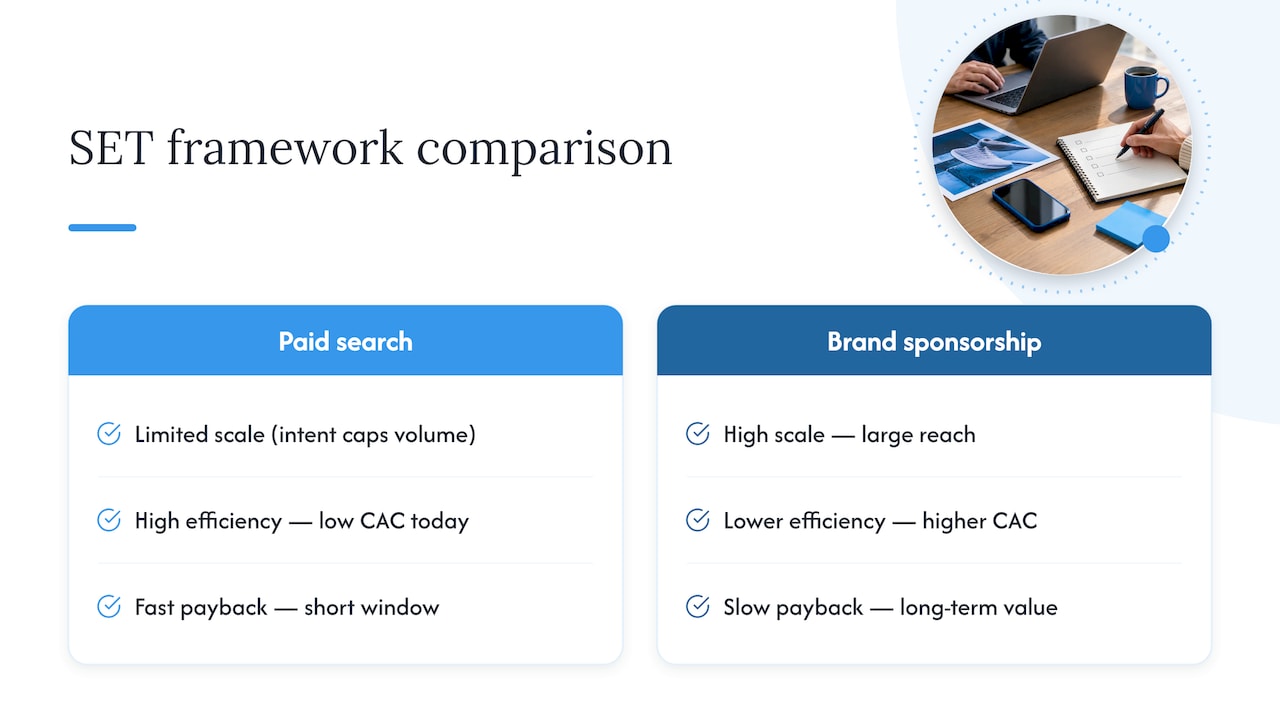
SET: Scale, Efficiency, Time. Each channel or campaign gets evaluated on three axes before it earns budget. Scale asks how much volume the channel can absorb before returns diminish. Efficiency asks what it costs to acquire a customer there today, compared to your target CAC. Time asks how quickly the channel pays back, and whether that payback window matches your cash position. A paid search campaign might score high on efficiency and time but low on scale once you have exhausted high-intent search volume. A brand sponsorship might score low on time and efficiency but high on scale and long-term pricing power. Neither answer is wrong.
Funnel-stage translation. Once strategic goals are set (grow market share, defend margin, launch a new product), translate each goal into a funnel-stage share. A market-share goal usually means more top-of-funnel investment. A margin-defense goal usually means more spend on retention and consideration content that shortens the sales cycle and reduces discounting pressure.
Always-on versus opportunistic versus experimental. Split your tactical spend into three pockets: always-on channels that run continuously because they reliably hit target CAC, opportunistic spend that activates around seasonal moments or competitor gaps, and experimental spend reserved for channels or formats with no track record yet in your account. Businesses earlier in their growth curve should weight experimental spend higher, since they have less historical data to protect.
Testing new creative within that experimental pocket works best with a structured process rather than ad hoc swaps. A creative testing framework that isolates one variable at a time gives you a clean read on what is actually driving performance before you scale spend behind it.
Pro Tip: Review your SET scores quarterly, not annually. Channel efficiency shifts faster than most budget cycles account for.
Step-by-step: build your marketing budget in 7 actions
A defensible budget follows a sequence, not a spreadsheet template pulled from last year. Harvard Business School Online frames this around four core considerations: goals, metrics, target audiences, and attribution. We expand that into seven concrete steps.
- Map business goals to measurable outcomes. Translate each business objective (revenue growth, margin protection, new market entry) into a specific channel KPI, so every dollar has a defined job to do.
- Collect and validate your inputs. Pull historical CAC, LTV, conversion rates by channel, and current unit economics. Reconcile any gaps between marketing’s numbers and finance’s numbers before the budget conversation starts, not during it.
- Apply benchmarks as a starting allocation. Use the percent-of-revenue and funnel-stage ranges above as your first draft, then adjust based on your validated inputs rather than the benchmark alone.
- Run scenario allocations. Build a best case, base case, and worst case for revenue and spend. This single step does more to earn finance buy-in than any other, because it shows you have already stress-tested the plan they are about to approve.
- Pace spend and set trigger rules. Decide in advance what performance threshold triggers a reallocation (for example, a channel missing target CAC for two consecutive months) so decisions during the year are rule-based rather than reactive.
- Assign ownership and reporting cadence. Name who owns each budget line, how often it gets reviewed, and when the next reforecast window opens. Monthly tactical reviews paired with quarterly strategic reforecasts work for most mid-size and larger budgets.
- Document assumptions in a board-ready narrative. Write down what you assumed about channel efficiency, market conditions, and competitive activity, so that if results diverge from plan, the conversation starts from “here’s what changed” rather than “here’s what went wrong.”
This sequence takes longer than copying last year’s split forward, but it produces a budget that survives a tough finance review and a plan that adapts cleanly when conditions shift mid-year.
Measurement, attribution, and governance: protecting and reallocating budget
Measurement choice determines whether your next budget conversation is evidence-based or political. Two approaches do most of the work, and they are complementary rather than competing.
Marketing mix modeling (MMM) analyzes aggregate spend and outcome data over time to estimate each channel’s contribution, including the slower-moving brand effects that short-term attribution tends to miss. Controlled experiments and incrementality tests, by contrast, isolate one channel or campaign change and measure its true causal lift over a shorter window. Use MMM to guide strategic, quarterly-or-longer allocation decisions and use experiments to validate specific tactical bets before scaling them.
IPA’s review of winning 2024 campaigns recommends mixing MMM with experiments and extending the analysis window specifically to capture these effects.
Translate MMM outputs into governance rules rather than leaving them as a one-time report:
- Set a quarterly reallocation window tied to the MMM refresh cycle, so shifts in spend follow updated evidence rather than gut instinct.
- Define red flags in advance, such as CAC rising two months running or a channel’s incremental lift falling below its historical average.
- Require a two-data-source rule before any major reallocation: an MMM signal plus a supporting experiment, not one or the other alone.
- Protect a minimum brand floor so short-term pressure cannot zero out long-term investment in a single bad quarter.
A practical guide to marketing mix modeling walks through how to set this up without needing a dedicated data science team.
Common allocation failures and quick fixes
Most allocation problems repeat across businesses, and most have a straightforward fix once named clearly.
- Defensive brand cuts. When budgets tighten, brand spend is usually first to go because its payback is slower to show up in a weekly report. Detect this by checking whether your brand-to-performance ratio has drifted below 25% without a deliberate decision to put it there, and rebalance gradually rather than reversing the cut all at once.
- Hidden budget drains. Duplicate martech subscriptions, unused ad platform licenses, and overlapping agency retainers quietly eat 5 to 10% of most budgets. A quarterly tool audit against actual usage logs catches most of this.
- Measurement mix-ups. Relying on last-click attribution alone overstates bottom-of-funnel channels and understates brand and awareness spend. The fix is pairing attribution with MMM so the two data sources check each other rather than one number driving every decision.
- Static allocation. Locking a split in January and never revisiting it ignores everything the market tells you for the rest of the year. Build the trigger rules from the governance section above into the plan from day one.
Vertical Brands’ evidence and how we implement this approach
We built our approach around the same portfolio logic outlined above because fragmented vendor relationships make it hard to execute consistently. Integrating strategy, creative, performance marketing, and web development under one team aims to remove the handoff gaps that usually cause allocation plans to break down in execution rather than in theory.
An integrated approach can produce significant increases in purchases and bookings, outcomes that come from aligning creative, media, and conversion paths rather than optimizing one channel in isolation.
What this can look like in practice:
- Media planning built on the SET framework, so budget moves to the channels earning it rather than the channels that got it last year.
- Creative testing cycles that validate new formats before they absorb a larger share of the experimental pocket.
- Full-funnel execution, from brand strategy through website conversion, coordinated under one team.
Readers who want to go deeper on the measurement side can review our marketing mix modeling guide or our KPI dashboard guide.
Adjusting budget allocation based on market trends and competitive analysis
A budget set once a year and never revisited drifts out of sync with the market within a quarter. Watch two categories of signal and adjust against them deliberately rather than reactively.
Market trend signals include shifts in consumer behavior, changes in platform costs (a channel’s cost-per-click climbing steadily is a signal, not noise), and macroeconomic pressure on your category’s demand. Competitive signals include a competitor’s sudden increase in share of voice, a new entrant targeting your core segment, or a rival cutting prices in a way that threatens your margin position.
The practical response is not to match competitors dollar for dollar. It is to decide, in advance, which signals warrant a reallocation and which warrant holding steady. A competitor’s short-term promotion rarely justifies panicking your brand budget. A sustained shift in where your category’s audience spends attention usually does. Build this judgment into the trigger rules from your governance plan, so market shifts get evaluated against pre-agreed thresholds rather than whoever raises the loudest objection in a budget meeting. Revisit channel-level allocation quarterly at minimum, and treat any reallocation above a meaningful threshold of total budget as a decision that needs the same scenario modeling you used to build the original plan.

Incorporating flexibility and contingency planning in the marketing budget
A budget with zero flexibility breaks the first time a channel underperforms or an opportunity appears mid-quarter. Build contingency into the plan itself rather than treating it as an exception to request later.
Keep this pocket separate from your experimental budget: experimentation is planned risk-taking, while contingency is unplanned response capacity.
Define, in the plan itself, what qualifies as a contingency trigger. A channel missing its CAC target for two consecutive reporting periods might release funds for reallocation. A sudden competitive opportunity, like a competitor’s product recall or a viral moment in your category, might justify tapping the contingency pocket on short notice rather than waiting for the next quarterly review.
Document how contingency funds get approved before you need them. A pre-agreed approval path (who signs off, what evidence is required, how fast a decision needs to move) turns a contingency pocket from an unused line item into a real operational tool. Businesses that skip this step often end up with contingency budget that sits unspent all year, or gets raided for the wrong reasons under pressure.
Aligning budget allocation with customer segmentation and targeting
Budget allocation works best when it follows your highest-value segments rather than a flat channel split applied across your entire audience. Start by ranking segments on LTV and acquisition cost, not just size, since your largest segment is not always your most profitable one.
Once segments are ranked, allocate funnel-stage spend differently for each. A high-LTV, low-awareness segment usually justifies heavier top-of-funnel investment to build recognition before conversion spend pays off. A segment that already converts well but at thin margins might warrant more investment in retention and upsell than in fresh acquisition.
Targeting precision also changes which channels deserve budget. A tightly defined B2B segment often performs better on channels that support detailed targeting criteria, while a broad consumer segment might get more value from channels optimized for reach. Avoid applying your overall channel mix evenly to every segment. Build the allocation at the segment level first, then roll it up into the total budget, so your top-line split reflects where your best customers actually are rather than an average that serves no one particularly well.
Tools and software for tracking and optimizing your budget
Budget governance only works if you can see spend and performance in one place, updated often enough to act on. A handful of tool categories cover most of what mid-size and larger marketing teams need.
Marketing mix modeling platforms handle the long-term, multi-channel attribution work that last-click tools miss entirely. Dashboard and reporting tools pull spend and performance data from each channel into a single view finance can review without needing a walkthrough. CRM and revenue attribution tools connect marketing spend to actual pipeline and closed revenue, which matters more than click-through data once a budget conversation reaches the finance team.
Choose tools based on what decision they support, not on feature lists. A dashboard that shows spend by channel but not by funnel stage will not help you apply the funnel-stage splits from earlier in this plan. A practical KPI dashboard guide walks through which metrics actually belong on a budget-tracking dashboard versus which ones are noise. For measurement frameworks specifically built to translate into finance-friendly reporting, GoStellar’s guide to measurement frameworks is a useful reference on structuring ROI reporting that survives a board-level review.
Case studies illustrating successful budget allocation strategies
The clearest evidence for portfolio-based allocation comes from campaigns that measured long-term effects rather than stopping at short-term sales lift. The 2024 IPA Effectiveness Awards recognized winning strategies built specifically on this kind of extended measurement window, showing that sustained brand investment paired with performance spend produced pricing power and payback that short-term analysis alone would have missed entirely.
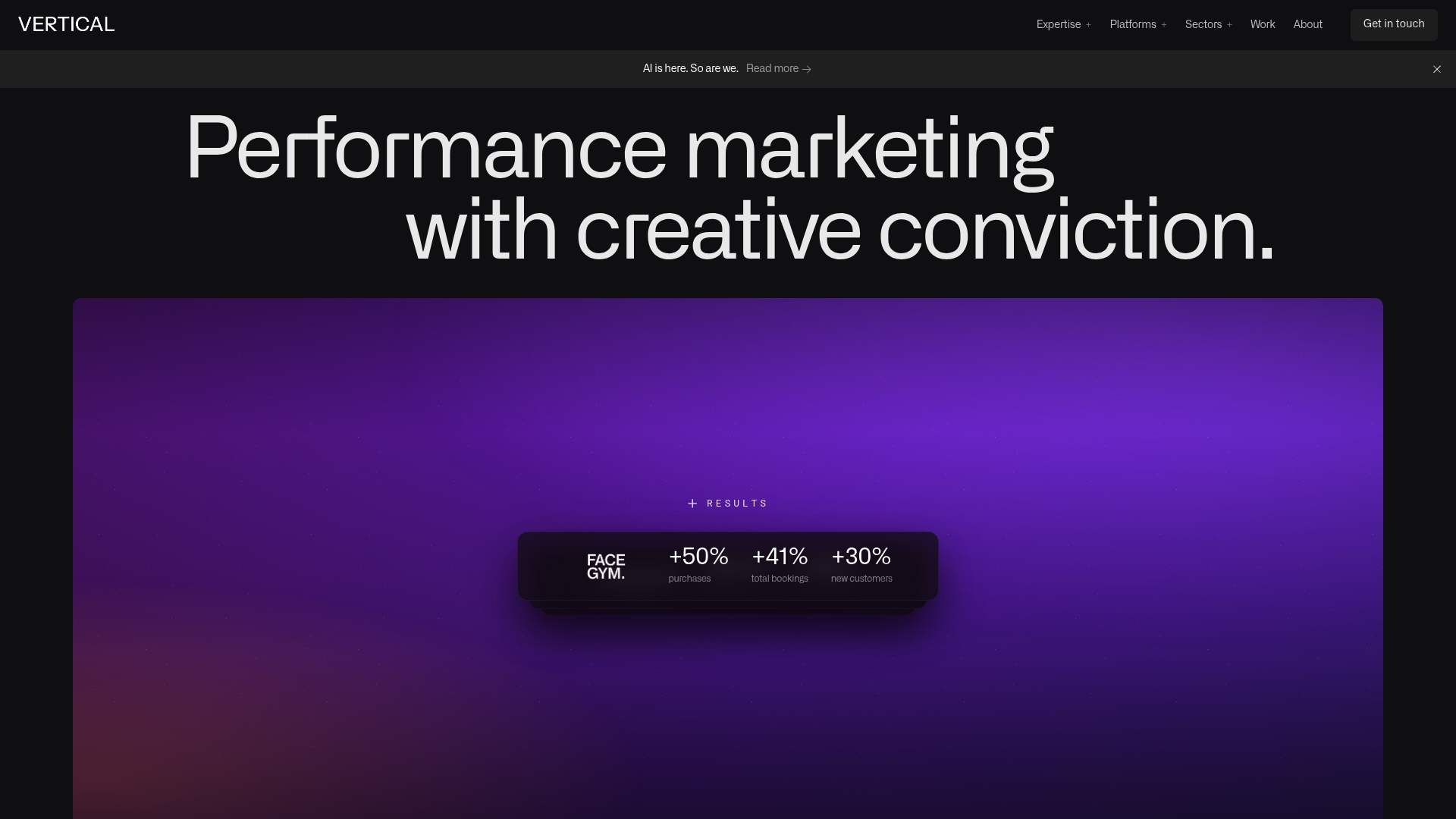
Our own work with FACEGYM reflects the same pattern at a smaller scale. The lesson from both examples is consistent: the businesses that measure and fund brand and performance together, rather than treating one as the “real” budget and the other as discretionary, are the ones whose results hold up under a longer measurement window.
Author perspective: when to be conservative and when to take bold bets
Portfolio thinking beats knee-jerk cuts because it forces a decision before the pressure hits, not during it. Three lines worth keeping ready for a budget conversation: brand cuts raise acquisition costs later, even when sales look fine this quarter. A reallocation needs two data sources agreeing, not one dashboard and a hunch. Flexibility built into the plan beats flexibility requested after the fact.
— Alex
How Vertical Brands can help with your budget allocation
Building a defensible, portfolio-based budget is straightforward to describe and genuinely hard to execute when strategy, creative, media, and web development sit with different vendors who rarely talk to each other. Removing friction by integrating these functions helps ensure that frameworks like SET scoring, funnel-stage splits, and governance rules get implemented consistently rather than lost in handoffs.
Our relevant services include media planning, paid social and paid search management, creative testing, marketing mix modeling support, and full website and funnel execution, all listed on our services page. If you want a second opinion on your current split or help building the scenario models your finance team will ask for, get in touch through our services page to start that conversation.
FAQ
What is the 70/20/10 rule in marketing?
It works as a default split for mid-stage businesses that need stability while still funding innovation.
What is the 70-10-10-10 budget rule?
It suits teams that want clearer separation between different types of risk rather than one blended innovation bucket.
What is the 3-3-3 rule for marketing?
The 3-3-3 rule is a creative and targeting heuristic: test three audiences, three channels, and three message angles in parallel before committing significant budget to any one combination. It works best applied at the campaign level rather than as an annual allocation framework.
How much budget should be allocated to marketing?
The right amount depends on growth stage, but Gartner’s 2026 research puts the average marketing budget near 7.8% of company revenue, with paid media accounting for 31.4% of that spend. Earlier-stage and scaling businesses often allocate a higher share tied to growth targets rather than a flat percentage.
Sources
- CMO Spend in 2026: Redefining Marketing Investment Under Constraint — Gartner
- Five winning strategies from the 2024 IPA Effectiveness Awards — IPA
- How to Create a Digital Marketing Budget: 4 Considerations — HBS Online
Recommended

Other posts

































































Stay ahead with better decisions.
Get business insights today.
