90 Day Integrated Marketing Strategy Playbook for Marketing Leaders

An integrated marketing strategy coordinates every channel, message, and customer touchpoint around one shared plan, so a prospect gets a consistent experience whether they see a paid ad, open an email, or walk into a store. The direct payoff is efficiency and lift: less wasted creative production, clearer attribution, and stronger campaign performance because every channel reinforces the same story instead of competing for attention. The rest of this guide shows you how to build, govern, and measure one.
TL;DR:
- Most integration failures stem from drift in messaging, ineffective channel prioritization, or poor data hygiene that undermines personalization efforts.
- Regular, short alignment calls, shared KPIs, and a single customer data view are essential to maintain coordination among channels and prevent drift.
- Prioritize channels based on their impact at different funnel stages, and build campaigns sequentially starting with foundation work like messaging, asset libraries, and data quality.
- Success relies on a unified tech stack that connects data, triggers, and assets via APIs, avoiding full system overhauls in favor of incremental integration.
- Effective measurement involves layered metrics at the channel, journey, lifecycle, and incrementality levels, with a strong emphasis on lift tests over isolated channel metrics.
Table of Contents
- What Is an Integrated Marketing Strategy, and Why Does It Matter?
- The Governance That Keeps Integration From Falling Apart
- How Do You Build an Integrated Marketing Strategy Step by Step?
- What Tech and Data Foundations Does Integration Require?
- How Should You Measure an Integrated Marketing Strategy?
- What Do Successful Integrated Campaigns Look Like?
- Where Integrated Marketing Strategies Break Down (and How to Fix Them)
- How Do You Align Sales and Marketing Within an Integrated Strategy?
- How Should You Allocate Budget Across Integrated Marketing Campaigns?
- How Do You Sequence and Time Integrated Marketing Initiatives?
- What Separates Good Integrated Strategies From Great Ones?
- How Vertical Brands Builds Integrated Marketing Programs
- Sources
- FAQ
What Is an Integrated Marketing Strategy, and Why Does It Matter?
Integrated marketing, sometimes called integrated marketing communications (IMC), means every channel, from paid social to email to your website, works from the same customer data, the same core message, and the same measurement framework. That’s different from simply running on multiple channels. Multichannel marketing means you show up in a lot of places. Integration means those places talk to each other, share data, and hand customers off cleanly from one touchpoint to the next.
The distinction matters because integration is not “use more channels.” Success depends on how deeply those channels connect and how well the data behind them gets used to tailor each touchpoint. A brand running five disconnected campaigns isn’t integrated. A brand running two tightly coordinated campaigns that share creative, audience data, and a single reporting view usually is.
The benefits show up in three places:
- Consistency. Customers recognize your voice and offer across every channel, which reduces the confusion that kills conversion.
- Efficiency. One core message and asset library gets repurposed across formats instead of rebuilt from scratch for each channel.
- Higher ROI. Coordinated campaigns compound. A retargeting email that echoes the ad someone just saw converts better than a generic blast.
- Better customer experience. Nobody gets a “welcome” email three weeks after their fifth purchase because the systems actually know what happened.
The research on consistency backs this up directly: brands that maintain consistent voice, visuals, and messaging across channels show measurably stronger commercial outcomes than brands that treat each channel as its own island.
Three principles hold this together. First, put the customer’s actual journey ahead of your org chart. Second, protect message continuity, meaning every channel says a version of the same thing, not a different thing. Third, treat channels as complementary, not redundant. Paid search catches intent, email nurtures it, and your website converts it. None of them should be trying to do all three jobs alone.
The Governance That Keeps Integration From Falling Apart
A strategy document doesn’t keep channels aligned. Governance does. Most integrated programs that unravel do so not because the plan was wrong, but because nobody owned the coordination once execution started.
Start with a single source of truth: one dashboard, one customer data view, one set of KPIs that every channel owner reports against. Without it, messaging drifts and personalization stalls because nobody agrees on what “the customer” actually looks like this quarter.
From there, pick an ownership model that fits your size:
- Hub-and-spoke. A central strategy team sets direction and brand standards; channel specialists execute within those guardrails. Works well for mid-size teams that need consistency without a bottleneck.
- Pods. Cross-functional teams (a strategist, a creative, a media buyer) own a specific audience segment or product line end to end. Works well once you’re running enough volume that one central team can’t review everything.
- DACI or RACI mapping for decisions. Name who is Driver, Approver, Contributor, and Informed (or Responsible, Accountable, Consulted, Informed) for every recurring decision, like creative sign-off or budget shifts, so approvals don’t stall in email threads.
Gartner’s research on marketing structure points to a sharp shift in operating model around the $50 million revenue mark, where teams typically split into six functions: growth, product, brand, content, creative, and operations. Below that inflection point, hub-and-spoke tends to work fine. Above it, pods usually make more sense.
The part most teams skip: tying incentives to shared KPIs. If your paid social lead is bonused on cost-per-click and your lifecycle lead is bonused on retention, they’ll optimize against each other every time. Build shared metrics into both scorecards.
Pro Tip: Run a 15-minute weekly alignment call across channel owners, not a full campaign review. The goal is just to catch drift before it compounds into a quarter of mismatched messaging.
How Do You Build an Integrated Marketing Strategy Step by Step?
Building the strategy is a sequence, not a brainstorm. Skip a step and the ones after it wobble.
1. Set SMART objectives tied to business outcomes. Every integrated plan needs objectives that are Specific, Measurable, Achievable, Relevant, and Time-bound, and they need to map to something the business actually cares about. “Increase brand awareness” isn’t SMART. Pick one or two primary KPIs per objective so channel owners aren’t chasing five metrics at once.
2. Map customer touchpoints and build channel-specific personas. This is where most teams either do too little or too much. You don’t need ten personas. You need to know, for your two or three real buyer segments, what questions they ask at each journey stage and where they actually spend time. The Medill IMC program’s framework for this is simple: identify segments, develop personas from real behavior data, map the customer journey stage by stage, and tailor messaging to what each stage actually needs. That last part matters because 40% of consumers say brands don’t understand them as individuals, which is usually a symptom of generic, journey-blind messaging rather than a targeting problem.
Voice of customer research, meaning surveys, social listening, and post-purchase feedback, is how you find the actual language customers use, not the language your internal deck uses. That gap is usually bigger than teams expect.
3. Create one core message, then build adaptable assets around it. Write the single sentence that describes what you’re offering and why it matters, before you write a single ad or email. Every channel’s creative should be a translation of that sentence, not a separate idea. This is also where repurposing pays off: a customer testimonial video becomes a 15-second social clip, a landing page block, and a quote in a sales deck. Adobe’s research on creative consistency found that repurposing assets this way both cuts production cost and reinforces the same message across formats.
4. Choose channels by funnel stage, not by habit. Map channels against where they actually do the most work:
- Awareness: paid social, display, influencer or UGC content
- Consideration: search, retargeting, email nurture sequences
- Conversion: website, sales enablement content, retargeting with urgency-based offers
- Retention: lifecycle email, CRM-triggered messages, loyalty programs
Channel prioritization, not channel omnipresence, is what actually drives results. Put your budget where customer behavior shows real impact, and resist the pull to launch on every platform just because a competitor did.
5. Assign channel owners and set orchestration rules. Someone owns each channel, but someone also owns the sequencing between channels: what triggers an email after an ad click, how long before a retargeting ad fires, and when to suppress a channel because the customer already converted elsewhere. Before launch, run through a short checklist: Is the core message consistent across every asset? Does every channel owner know the shared KPI they’re accountable for? Is suppression logic built so a converted customer doesn’t keep getting prospected? Is there one dashboard everyone will check on Monday morning?
What Tech and Data Foundations Does Integration Require?
Orchestration is only as good as the data feeding it. Without a unified customer view, personalization breaks down the moment you try to scale it past a handful of manual campaigns.
The center of that architecture is a unified customer profile, whether that’s a customer data platform (CDP) or a well-consolidated CRM, that stitches together identity across devices and channels so an email click and a website visit get recognized as the same person. Around that core, three things matter:
- Event and consent design. Track the events that actually predict behavior (cart abandonment, content downloads, support tickets), and build consent capture into every collection point so personalization stays privacy-compliant from day one.
- Tag governance. A messy tagging setup is the single most common reason attribution data becomes unusable within a year. Assign an owner and an audit schedule.
- An orchestration layer plus a shared asset library. APIs connect your CDP to your ad platforms, email tool, and website so a segment update flows everywhere automatically instead of getting manually rebuilt in five places.
One practical rule from the martech world worth internalizing: prefer an orchestration layer paired with a lightweight CDP over a risky full rip-and-replace of legacy systems. API-based integration is faster to deploy and far lower risk than trying to swap your entire stack at once, and it gets you most of the personalization benefit without the twelve-month migration.
Brands like Panera Bread and KFC Spain have used exactly this model, unifying CRM, email, push, in-app, and out-of-home data to drive measurable campaign lifts without rebuilding their entire tech stack from scratch. If you’re weighing where AI fits into that orchestration layer, it’s worth reviewing when to automate versus keep manual before you plug a tool into every workflow.
How Should You Measure an Integrated Marketing Strategy?
Channel-level metrics tell you almost nothing about whether integration is working. A campaign can hit every individual channel’s target and still fail to move the business, because the channels never got credit for working together.
Measure at four levels instead of one:
- Channel-level: click-through rate, cost per click, engagement rate. Useful for optimizing a single tactic, not for judging the whole strategy.
- Journey-level: conversion rate across the full path, cost per acquisition, time-to-conversion. This is where integration either shows up or doesn’t.
- Lifecycle metrics: retention rate, customer lifetime value, repeat purchase rate. The real test of whether integrated messaging built a relationship or just closed a transaction.
- Incremental lift: what holdout and control groups tell you the campaign actually caused, versus what would have happened anyway.
Braze’s research on integrated measurement recommends exactly this layered approach, pairing conversion rate and cost-per-acquisition tracking with dedicated lift tests rather than relying on any single channel’s dashboard.
| Measurement level | Example metric | What it tells you |
|---|---|---|
| Channel-level | Click-through rate, CPC | Whether one tactic is efficient |
| Journey-level | Conversion rate, cost per acquisition | Whether the full path is working |
| Lifecycle | Retention rate, customer lifetime value | Whether the relationship is compounding |
| Incremental lift | Holdout group performance vs. control | What the campaign actually caused |
Holdout tests matter more than most teams give them credit for. Pull a random slice of your audience out of a campaign entirely, measure their behavior against the group that received it, and you get a real read on incrementality instead of a number inflated by people who would have converted anyway. Multi-touch attribution models help distribute credit across touchpoints, but they work best as a directional tool alongside lift testing, not a replacement for it.
For dashboarding, resist the urge to build one view with fifty metrics. Pick the two or three journey-level and lifecycle numbers tied to your original SMART objectives, and let channel-level metrics live in each team’s own reporting. If you need a starting structure, a KPI framework built for analysts is a reasonable template to adapt.
What Do Successful Integrated Campaigns Look Like?
The pattern behind strong integrated campaigns is almost always the same: one message, multiple formats, tight sequencing between channels.
- KFC Spain and Panera Bread both unified CRM, email, push notifications, in-app messaging, and out-of-home advertising around shared customer data, which let each channel pick up where the last one left off instead of repeating the same generic offer.
- FACEGYM’s engagement with Vertical Brands paired brand strategy, creative production, and performance media under one coordinated plan. The result was a significant increase in purchases and bookings, the kind of lift that comes from aligned creative and media working the funnel together rather than in parallel silos.
Three tactics from these examples are worth copying directly: build one asset library that every channel draws from instead of commissioning separate creative per platform, sequence retargeting so it references what the customer already saw rather than starting the pitch over, and route post-purchase customers into a retention track instead of leaving them in the acquisition funnel by default.
Where Integrated Marketing Strategies Break Down (and How to Fix Them)
Most integration failures trace back to one of three patterns, and all three have straightforward fixes.
Drift. Teams start aligned and slowly diverge as each channel optimizes for its own metric. The fix is structural: shared KPIs baked into every team’s scorecard, a short weekly alignment rhythm, and a governance owner who actually has authority to redirect a channel that’s wandering off-message. Practitioner consensus points to incentive misalignment as the most common root cause, not a lack of strategy documentation.
Trying to be everywhere. Launching on every platform because a competitor did spreads budget and creative too thin to matter anywhere. Prioritize the two or three channels where customer behavior data shows the biggest funnel impact, and treat everything else as experimental spend with a hard cap.
Poor data hygiene. Duplicate records, inconsistent event tracking, and missing consent flags quietly wreck personalization long before anyone notices. Run a prioritized data-cleanup sprint focused on your highest-value segments first, and build consent capture into every new data collection point going forward, not as an afterthought.
Pro Tip: If you can only fix one thing this quarter, fix data hygiene first. Every other pitfall gets easier to solve once your customer data is trustworthy.
How Do You Align Sales and Marketing Within an Integrated Strategy?
Sales and marketing usually break down over the same issue: they define a “qualified lead” differently, and nobody catches the mismatch until pipeline numbers don’t add up.
Fixing this starts with a shared definition, written down and agreed by both teams, of what counts as a marketing-qualified lead versus a sales-qualified one. Once that’s settled, build a feedback loop: sales reports back on lead quality on a regular cadence, and marketing adjusts targeting or messaging based on what actually closes, not just what generates form fills.
Shared KPIs help here too. If marketing is measured purely on lead volume and sales is measured purely on close rate, the two teams will optimize against each other. A shared metric, like pipeline value generated or revenue influenced within 90 days, gives both teams a reason to collaborate instead of pointing fingers at handoff quality.
Content is the other lever. Sales conversations surface the objections and language that actually move deals forward. Marketing rarely hears these firsthand unless there’s a deliberate process, like a monthly call or a shared Slack channel, for sales to flag what’s working in the field. That intelligence should shape the next round of messaging and creative, not sit in a call recording nobody reviews.
The teams that get this right usually have one more thing in common: a joint quarterly business review where both sides look at the same dashboard, agree on what changed, and adjust the plan together instead of debating whose numbers are right.
How Should You Allocate Budget Across Integrated Marketing Campaigns?
Budget allocation for integrated campaigns should follow funnel impact, not habit or internal politics. Start by mapping last year’s spend against last year’s actual conversion and retention data, not against which channel had the loudest advocate in the room.
A reasonable starting split for most mid-size programs weights spend toward the funnel stages generating the most measurable movement. If your journey-level data shows conversion bottlenecking at consideration, that’s where incremental budget should go first, even if awareness spend has historically gotten the biggest line item.
This is also where holdout testing pays for itself: if a lift test shows a channel’s incremental contribution is smaller than its budget share suggests, that’s the signal to reallocate before the next planning cycle, not after.
Cross-functional budget conversations work better when every channel owner is arguing from the same dashboard. If paid social and lifecycle email are both claiming credit for the same conversion, the budget conversation turns political fast. A single source of truth for attribution removes most of that friction before it starts.
How Do You Sequence and Time Integrated Marketing Initiatives?
Sequencing matters as much as channel selection. Launching every channel simultaneously without a plan for how they hand off to each other usually creates noise instead of momentum.
A practical sequence starts with foundation work: finalize the core message, build the shared asset library, and confirm the unified customer profile is actually populated with clean data. Skipping this step to launch faster almost always costs more time later, when campaigns have to pause for data fixes mid-flight.
From there, stagger channel launches by funnel stage. Awareness channels, like paid social and influencer content, typically launch first to build audience volume. Consideration and conversion channels, like retargeting and email nurture sequences, launch once there’s enough audience data flowing in to actually personalize them.
Plan review checkpoints into the timeline itself, not as an afterthought. A 30-day checkpoint to confirm tracking and messaging consistency, a 60-day checkpoint to review early lift data, and a 90-day checkpoint to decide what scales and what gets cut is a reasonable cadence for most mid-size programs. Building these checkpoints into the plan from day one keeps governance proactive instead of reactive, which is usually the difference between catching drift early and discovering it in a quarterly report.

What Separates Good Integrated Strategies From Great Ones?
Most integrated marketing plans fail quietly, not with a dramatic breakdown but with a slow drift where each channel starts optimizing for its own metric again. The strategy document was fine. The governance around it wasn’t.
The operational levers that actually move results are unglamorous: a real single source of truth, a weekly rhythm that catches drift in days rather than quarters, and an asset library that makes repurposing the default instead of the exception. FACEGYM’s results with Vertical Brands, a 50% lift in purchases and a 41% rise in bookings, came from exactly that combination of aligned strategy, creative, and media working one plan instead of three separate ones.
If your current setup can’t tell you, in one dashboard, whether your channels reinforce or contradict each other, that’s the place to start. A short audit or a 90-day pilot will surface it faster than another planning document will.
— Alex
How Vertical Brands Builds Integrated Marketing Programs
An integrated marketing team runs strategy, creative, performance media, and web development as one group, so the integration this guide describes doesn’t depend on multiple vendors trying to sync up after the fact.
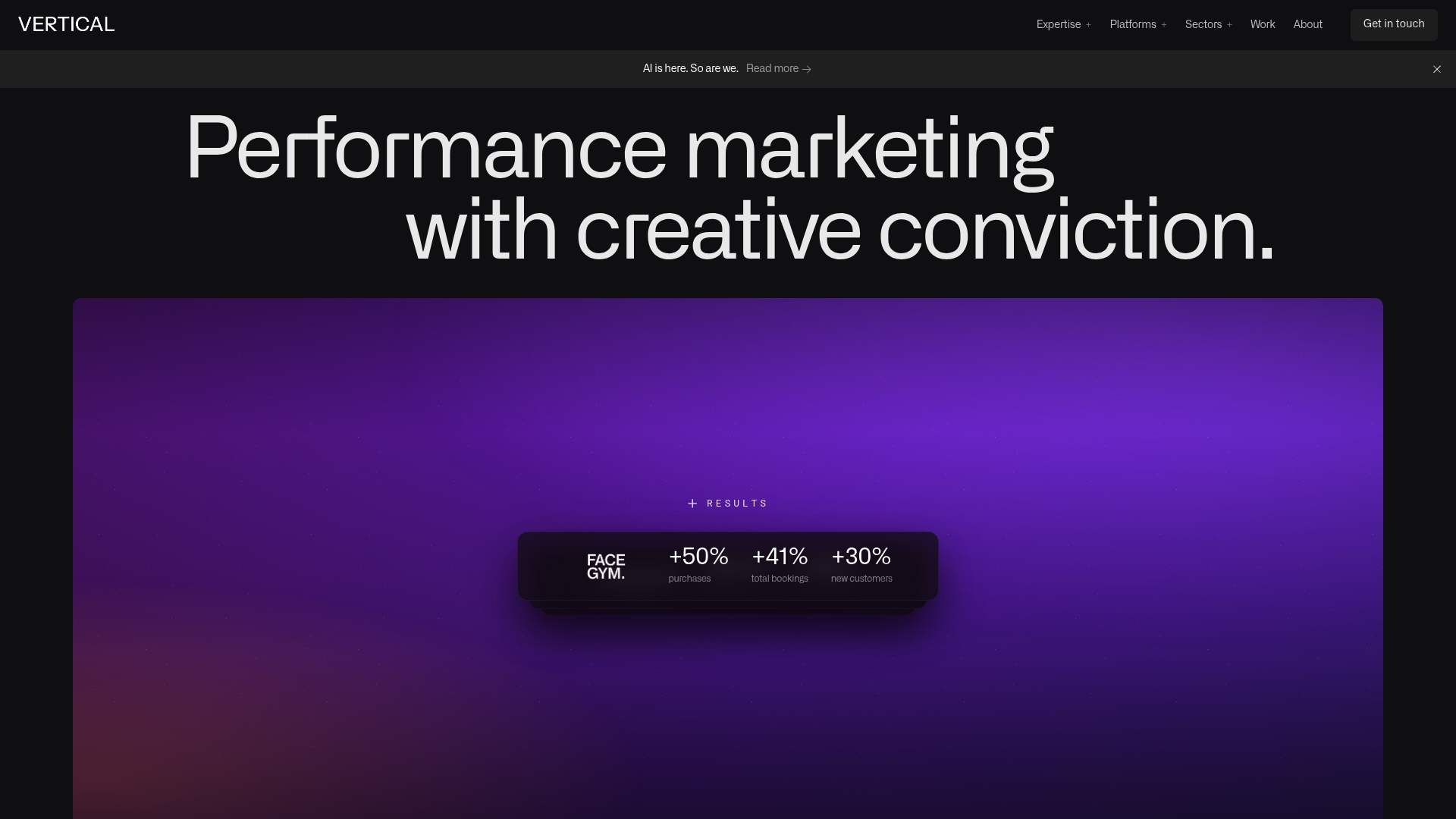
That structure is the practical difference for a marketing leader deciding whether to keep managing five vendors or consolidate into one accountable team: one shared customer view, one creative direction, and one group answering for results instead of pointing at the agency next door. FACEGYM saw a 50% increase in purchases and a 41% rise in bookings working this way, proof that coordinated strategy and execution compounds faster than parallel, disconnected campaigns. If your channels are technically all running but not reinforcing each other, a focused audit or a 90-day pilot is usually enough to show where the gaps are. Start with a conversation about your current setup and see what a genuinely integrated plan would look like for your team.
Sources
- Marketing department structure — Gartner
- Integrated marketing strategy — Braze
- How to create an integrated marketing plan — Medill IMC Professional
- Integrated Marketing Definition, Uses and Examples — Adobe
FAQ
What Is an Integrated Marketing Strategy?
It’s a plan that coordinates messaging, creative, and data across every channel so a customer gets one consistent experience, improving both campaign performance and measurable ROI.
What Are Examples of Integrated Marketing?
Panera Bread and KFC Spain both unified CRM, email, push, and in-app messaging around shared customer data, and Vertical Brands’ work with FACEGYM combined strategy, creative, and performance media to lift purchases by 50% and bookings by 41%.
What Are the Five Components of IMC?
Definitions vary slightly by source, but the components most consistently cited are advertising, public relations, sales promotion, direct marketing, and personal selling, all coordinated under one message and one customer data view.
What Are the Four C’s of Integrated Marketing?
The commonly cited four C’s are coherence, consistency, continuity, and complementary channel roles, meaning every channel says a compatible version of the same message and plays a distinct part in the customer journey.
How Do I Know if My Marketing Is Actually Integrated?
If you can pull one dashboard showing journey-level conversion and lifecycle metrics across every channel, and every channel owner reports against the same shared KPIs, your marketing is integrated. If each channel has its own separate scorecard, it isn’t yet.
Recommended

Other posts



























































Stay ahead with better decisions.
Get business insights today.
