Get Cited by AI: Generative Engine Optimization Tested for Marketers

Generative engine optimization, or GEO, is the practice of shaping content so AI systems like ChatGPT, Gemini, and Perplexity can extract it, trust it, and cite it directly in their answers, a discipline also called AEO. The single highest-impact action to start with is making your content self-contained and fact-packed so an AI engine can lift a passage whole and attribute it to you. Everything below builds on that foundation, from the technical groundwork to how you measure whether any of it worked.
TL;DR:
- Content must be self-contained, with clear claims, specific numbers, and quotations to increase its quoteability in generative engine responses.
- Technical SEO elements like schema markup, crawl accessibility, and URL stability are critical, as blocked bots and inconsistent data prevent content from being cited.
- Building focused topic clusters with internal links and earned third-party validation boosts the likelihood of being referenced by AI models.
- Measuring GEO success requires dedicated UTM tracking, citation frequency sampling, and mapping AI referrals to actual conversions, separate from traditional SEO metrics.
- A 30-day pilot should focus on revising high-traffic pages, fixing crawl issues, and monitoring citation changes to determine if GEO efforts are effective.
Table of Contents
- What generative engine optimization means and how it differs from SEO
- Why GEO matters now as answers replace clicks
- Core GEO strategies that increase citation probability
- Technical checklist for crawling, schema, and machine readability
- How to measure whether GEO is actually working
- Building topical authority through clusters and earned coverage
- What a 30-day GEO pilot looks like in practice
- How marketing, SEO, engineering, and PR should work together on GEO
- How we help teams execute a GEO program
- FAQ
- Sources
What generative engine optimization means and how it differs from SEO
GEO and traditional SEO share a goal: getting found. The mechanics diverge sharply. Traditional SEO optimizes for ranking position on a results page, where a searcher scans ten blue links and clicks one. Generative engines skip that step. They read across many sources, synthesize an answer, and decide which sentences or statistics deserve a citation. Your content is no longer competing for a slot; it is competing to be the exact passage an AI model decides to quote.

That shift changes which signals matter. Keyword density and backlink volume still count for discovery, but they do not guarantee inclusion in a generated answer. What matters more is whether a paragraph can stand alone, whether a claim is specific enough to quote, and whether the source carries independent credibility. According to foundational GEO research from arXiv, including citations, relevant quotations, and supporting statistics in content can meaningfully boost a site’s visibility in generative engine responses. Some practitioners use the term AI SEO interchangeably with GEO, though GEO specifically addresses content that generative models extract and synthesize, rather than content that merely ranks.
Why GEO matters now as answers replace clicks
Search behavior has changed enough that waiting on GEO carries real risk. AI-generated answers increasingly satisfy a searcher’s question before they reach a traditional results page, and a growing share of queries never produce a click to any website at all.
A 2025 comparative study found that generative engines favor earned third-party sources over brand-owned content, and that applying structured GEO methods such as citations and clear factual statements significantly improved visibility on the benchmarks tested, according to the empirical GEO strategic framework published on arXiv. That finding has two practical implications. First, content teams cannot rely solely on their own domain to carry weight with generative engines; earned coverage matters more than it did for classic SEO. Second, even when a generated answer does not send a click, appearing inside that answer still shapes brand consideration at the exact moment someone is deciding what to buy or trust. Influence inside the answer is the new currency, whether or not it shows up in your analytics as a session.
Core GEO strategies that increase citation probability
Winning citations from a generative engine comes down to how you write, how you structure information, and how much independent validation surrounds your brand. None of these tactics require new infrastructure, which makes them the fastest lever most teams can pull.
- Front-load the claim. Put the main point in the first sentence of a paragraph, since generative engines frequently extract single passages and favor the one that states its conclusion immediately.
- Write self-contained paragraphs. Each paragraph should make sense without the one before it, because an AI model may lift it in isolation.
- Add specific numbers and quotations. A precise statistic or a direct quote is more quotable than a vague generalization, and it signals the kind of evidence generative models are trained to surface.
- Use consistent entity naming. Refer to a product, person, or concept the same way throughout a page so the engine can disambiguate it with confidence.
- Build extractable formats. Definitions, short comparison lists, and compact FAQ blocks are structured for exactly the kind of lifting generative engines do.
Earned mentions deserve equal priority alongside on-page work. A data citation in a trade publication or a quote picked up by a third-party outlet carries weight that a brand’s own blog post cannot replicate, particularly given the earned-media preference the arXiv framework documented above.
Pro Tip: Rewrite your five highest-traffic pages’ opening paragraphs so each one answers the page’s core question in the first sentence, before touching anything else on the page.
Technical checklist for crawling, schema, and machine readability
Content quality means little if a generative engine’s crawler cannot reach or parse your pages. A short technical pass closes most of the common gaps.
- Allow search-specific bots explicitly. Block training-only crawlers where you need to, but confirm bots like OAI-SearchBot can access the pages you want cited, since over-blocking in robots.txt is one of the most common reasons content never appears in AI answers, per OpenAI’s publisher guidance.
- Mark up products, offers, reviews, and organization data with Schema.org. Structured data gives generative engines a machine-readable version of facts that might otherwise require interpretation, and it should match the visible page content exactly to avoid mistrust or misattribution.
- Add ARIA roles and accessibility markup. Agentic systems increasingly navigate pages the way assistive technology does, and the same roles that help a screen reader also help an AI browse and act on your site.
- Eliminate infinite-crawl traps. Dynamic query strings and unbounded URL parameters waste crawler budget and can prevent an engine from ever reaching your canonical pages.
- Keep URLs stable and canonical. A page that moves or duplicates under multiple paths fragments the authority a generative engine would otherwise consolidate into one citation-worthy source.
For a deeper technical pass, our guide to what a technical SEO audit actually fixes walks through the same crawl and schema issues in more depth.
Pro Tip: Run a crawl simulation with your allow-listed bots before you publish a GEO-focused page, since a blocked asset or orphaned URL will quietly undo every content improvement you make.
How to measure whether GEO is actually working
GEO needs its own measurement layer, separate from standard SEO reporting, because the traffic and citation patterns look different.
- Track AI referral traffic by UTM. ChatGPT includes
utm_source=chatgpt.comin its referral URLs, so configuring GA4 to segment this traffic shows you exactly how much visibility is converting into visits, as described in OpenAI’s publisher FAQ. Our UTM naming conventions guide is a useful reference for keeping this tracking consistent across platforms. - Sample citation frequency weekly. Run your target prompts through major generative engines on a regular cadence and log whether and how often your brand gets cited.
- Calculate a rough share-of-voice. Compare how often you appear in generated answers against how often competitors do, for the same set of prompts.
- Map AI referrals to downstream conversions. Once GA4 isolates AI-sourced sessions, tie them to the same revenue and conversion goals you already track for organic search.
Generative engines are a new, measurable referral channel, not a black box, once you set up UTM tracking the way OpenAI documents it. A weekly citation sample paired with a monthly conversion review gives most teams enough signal to judge whether their GEO work is paying off.
Building topical authority through clusters and earned coverage
Generative engines reward depth on a topic more than they reward volume of pages, which makes a focused content cluster more effective than scattered one-off posts.
- Build one pillar page and five to seven subtopics. The pillar answers the broad question; each subtopic answers a narrower variation that maps to how people actually phrase prompts.
- Write three to five focused briefs per subtopic. Each brief should target a distinct prompt pattern rather than restating the pillar page in different words.
- Interlink the entire cluster and keep schema consistent. Canonical URLs and matching structured data across every page in the cluster help a generative engine recognize the set as one coherent, authoritative body of work.
- Earn third-party validation around the cluster. Press coverage, independent reviews, and data citations in outside publications matter more to a generative engine’s trust signals than raw backlink counts, consistent with the earned-media preference found in the arXiv GEO framework.
A tightly interlinked set of pages focused on one topic tends to outperform a much larger number of disconnected posts when it comes to AI visibility, which is the opposite of how many content calendars are still built today.
What a 30-day GEO pilot looks like in practice
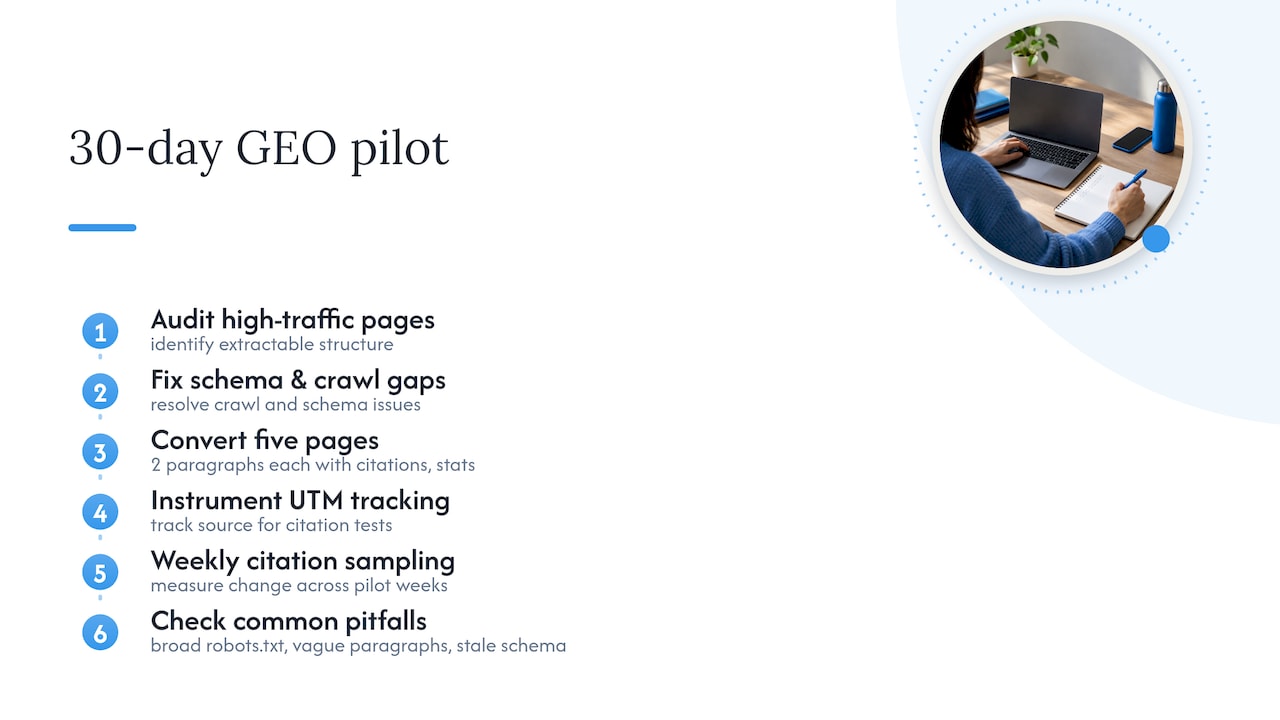
A focused pilot is enough to tell whether GEO is worth a fuller investment. Start with an audit of your highest-traffic pages, since this reveals quickly which already have extractable structure and which need rework. Fix any obvious schema or crawl gaps first, since those are often the reason content never gets considered at all.
Following the structure outlined in the original GEO research, a repeatable pilot identifies five high-opportunity pages, converts two paragraphs on each into extractable micro-content with citations and statistics, instruments UTM tracking, and runs weekly citation sampling to measure the change. The most common pitfalls we see teams fall into are overly broad robots.txt rules that block search-specific bots, paragraphs too vague to quote, and schema that was added once and never kept in sync with the page.
How marketing, SEO, engineering, and PR should work together on GEO
GEO breaks down when it sits inside one team’s job description. The strongest results come from treating it as a shared operating rhythm rather than a one-time project.
We think topical authority and earned mentions deserve more budget than isolated sentence-level tweaks, since the research consistently shows generative engines weighting independent validation over polish. Schema accuracy and crawl checks belong inside regular engineering sprints, not a once-a-year audit, because a single blocked bot can undo months of content work overnight. Weekly citation sampling paired with a monthly review of cluster health keeps the whole effort honest instead of letting it drift into guesswork. The teams that treat GEO as a cross-functional habit tend to see compounding gains that a single department working alone rarely matches.
— Alex
How we help teams execute a GEO program
We built our approach around the same problem GEO surfaces: marketing work scattered across vendors rarely compounds into a coherent authority signal, whether you are optimizing for a search engine or a generative one. Our integrated team pairs content strategy, technical SEO, PR, and measurement under one roof, which matters when a single blocked crawler or missing citation can undercut months of writing.

If you are ready to test this on your own site, we recommend starting with an audit rather than a full rebuild:
- Technical and content audit to find crawl blocks, missing schema, and pages with citation potential.
- A focused pilot converting your highest-opportunity pages into extractable, citation-ready content.
- Measurement setup connecting AI referral tracking to the conversions you already report on.
You can see our full range of digital marketing and technical SEO services and get a straightforward read on where your content stands today.
FAQ
Is generative engine optimization a real discipline?
Yes, GEO is a recognized and actively researched practice, with foundational work published in academic research on arXiv measuring how specific content changes affect visibility in generative engine answers. It sits alongside traditional SEO rather than replacing it outright.
How should a beginner start learning SEO?
Start with the fundamentals of how search engines crawl, index, and rank pages, since GEO builds directly on that foundation rather than replacing it. From there, study how generative engines extract and cite content differently, using resources like Google’s developer guidance and platform-specific publisher documentation.
Is GEO replacing SEO entirely?
No, GEO extends SEO rather than replacing it; both disciplines still depend on crawlable, well-structured, authoritative content. The difference is that GEO adds a layer focused on extractability and citation, which arXiv’s GEO framework treats as a distinct set of tactics on top of standard optimization.
Is traditional SEO going away because of AI search?
Traditional SEO is not disappearing, but its role is shifting as generative answers absorb a growing share of queries before a click ever happens. The core practices, crawlability, structured data, and earned authority, remain the backbone that both SEO and GEO depend on.
What’s a simple first step to improve AI citation odds?
Rewrite your top few pages so the first sentence of each key paragraph states its main claim plainly, since generative engines frequently extract single passages in isolation. Pair that with accurate schema markup and confirmed crawler access, since a technically blocked page cannot be cited regardless of how well it is written.
Sources
- 2311.09735 GEO: Generative Engine Optimization
- Publishers and Developers - FAQ | OpenAI Help Center
- Empirical analysis and GEO strategic framework (arXiv)
Recommended

Other posts
































































Stay ahead with better decisions.
Get business insights today.
