B2B Lead Attribution: How to Trace Pipeline Back to Source

B2B lead attribution means recording where each lead came from, carrying that record through your CRM, and tying it to the deals that close. Do that and you can say which channels produce revenue, not just form-fills. The work is mostly structure: clean source fields, offline conversions sent back to ad platforms, consent handled properly, and a way to capture the buyers your tracking cannot see.
This guide is for UK marketing and revenue leaders who have a dashboard full of leads and little confidence about which ones matter.
TL;DR
- Separate lead source (a long-lived channel label) from campaign (the specific initiative). Mixing them breaks ROI reporting.
- Send CRM outcomes, such as sales-qualified leads and closed-won deals, back to your ad platforms as offline conversions, using hashed first-party data.
- In the UK, attribution depends on consent. Without a working consent setup, your data is incomplete or non-compliant.
- Much of the B2B buying journey happens where no pixel can see it. Add a self-reported “How did you hear about us?” field and treat it as real evidence.
- Measure at account level and on revenue, not on raw lead volume.
Table of Contents
- What B2B lead attribution actually answers
- Lead source vs campaign: get the fields right first
- Offline conversion tracking: send revenue back to the platforms
- Consent comes first in the UK
- The dark funnel: what your tracking cannot see
- Measure accounts, not just leads
- Our perspective
- A 30-day plan to get started
- Where we can help
- FAQ
- Sources
What B2B lead attribution actually answers
Attribution answers one question: which marketing activity should get credit for this opportunity? In B2B that is harder than in consumer marketing, for three reasons.
- Sales cycles are long. A lead may first click an ad in January and sign in September.
- Buying is collective. B2B buying involves committees averaging 12 or more stakeholders, according to 6sense, so one form-fill from one person tells you little.
- The decisive moments are often private. Peer conversations, communities and AI assistants leave no trail in your analytics.
So good attribution is not one tool or one model. It is a chain: capture the source, store it correctly, connect it to revenue, and compare it with what buyers tell you directly. If you want the model side in more depth, we cover it in our guide to data-driven marketing attribution models.
Lead source vs campaign: get the fields right first
Most failed attribution reports trace back to one mistake. Teams use “lead source” and “campaign” as if they mean the same thing. Practitioners point to this confusion as a major root cause of unreliable reporting, because it prevents accurate ROI analysis.
The distinction is simple:
- Lead source is the origin of the lead. It is high level and stays fixed once set. Examples: Google Ads, LinkedIn, referral, outbound email, events.
- Campaign is the specific initiative that pushed the person to convert. Examples: a named ad set, a Q4 webinar, a product launch.
One CRM help guide describes the same parent and child hierarchy: sources are the parent channels, campaigns sit underneath. Its advice is to avoid creating a new source for every campaign, because that fragments your reporting and removes the ability to compare channels over time.
A simple field structure
| Field | Purpose | Example values | Who can edit |
|---|---|---|---|
| Original lead source | First known channel, never overwritten | Paid search, Paid social, Outbound email, Referral | Locked after creation |
| Lead source detail | Platform or placement | Google Ads, LinkedIn, Meta | Marketing ops |
| Campaign | The specific initiative | Q4 2026 pricing webinar | Marketing |
| UTM parameters | Raw capture from the click | utm_source, utm_medium, utm_campaign | Captured automatically |
| Self-reported source | What the buyer says | Podcast, colleague, ChatGPT | Captured from the form |
| Click ID | Matching for offline conversions | GCLID or equivalent | Captured automatically |
Keep the original lead source locked. If sales can overwrite it when a deal moves forward, you lose the one field that lets you compare channels honestly a year later.
Common ways the data goes wrong
- Untagged links in email and social posts, so traffic arrives as “direct”.
- Different spellings of the same source (“LinkedIn”, “linkedin”, “LI”) creating three channels.
- Sales reps creating leads by hand with no source at all.
- Campaign names that change format every quarter.
Fix these with a short naming guide, picklists instead of free text, and a monthly check for blanks. It is dull work, and it is what makes every later report trustworthy.
Offline conversion tracking: send revenue back to the platforms
An ad platform only knows that someone filled in a form. It does not know that the lead became a qualified opportunity, or that it closed for £80,000. Offline conversion tracking closes that gap by sending CRM outcomes back to the platform, so bidding and reporting reflect pipeline quality instead of lead volume.
The value can be large. Google reports that Paylocity, an HR and payroll provider, saw a 62% lift in conversion value and a 61% increase in MQL conversion rates after linking CRM outcomes to its ad platform in late 2025. That is one company’s result and not a promise for yours, but it shows why the approach is worth the effort.
The basic workflow
- Capture the click ID and form data at submission. Store the click ID (for Google Ads, the GCLID) and the contact details in hidden fields that pass into your CRM.
- Define the stages worth reporting. For most B2B teams that means sales-qualified lead, opportunity created and closed-won. Skip stages that sales do not apply consistently.
- Create a conversion action for each stage in the ad platform, set up as an import.
- Upload on a schedule. Daily is common. Use a native CRM integration, an API connection or a spreadsheet import, depending on your volume.
- Assign values. Use real deal values where you can, or average values per stage where you cannot.
- Switch bidding to the downstream conversion once enough volume has accumulated.
Hashing and matching
Having a click ID alone is not enough in all cases. Google’s guidance on enhanced conversions explains that the method captures hashed, user-provided customer data from the conversion point to improve measurement accuracy. Our research notes also point to normalizing first-party data (trimming, lowercasing emails, standardizing phone formats) and hashing it with SHA-256 before upload. Do this in your pipeline, not by hand, so the format stays identical every time.
Two practical warnings:
- If you also track the same conversion through a website tag, make sure the imported action does not double-count it. Check how each conversion action is configured before you switch on automated bidding.
- Do not feed lower-quality stages into bidding by accident. Keep “lead” as a secondary action once you move to “qualified” or “closed-won”.
What if volume is low?
Many B2B accounts close only a handful of deals a month. Bidding on closed-won alone gives the platform too little to learn from. A sensible compromise is to optimize towards sales-qualified leads and report on closed-won separately. Move up the funnel only when volume supports it.
Consent comes first in the UK
If you sell to UK buyers, attribution and privacy are one project. Google’s enhanced conversions guidance stresses that you need a consent framework in place, and that user consent must be managed properly for the data to be used. Where visitors decline cookies, you will see gaps in your reporting. Consent Mode lets platforms model some of the missing conversions, but only if it is implemented correctly.
Practically, that means:
- A cookie banner that records choices and passes them to your tags.
- Consent Mode configured to match those choices.
- Only first-party data that you have a lawful basis to use goes into any upload.
- Your privacy notice explains how form data is used for measurement and advertising.
We walk through the technical side in our guide to Consent Mode V2 implementation. If email is part of your pipeline, see also UK GDPR and email marketing consent. For questions about your lawful basis, speak to your data protection officer or a solicitor who handles UK data protection. This article is not legal advice.
The dark funnel: what your tracking cannot see
Even a perfect setup misses a lot. Buyers research in peer communities, private chats, podcasts and, increasingly, AI assistants. Estimates of how much of the journey is hidden vary. One analysis says the dark funnel hides 57 to 73% of B2B buyer journeys from attribution, while another cites Gartner research putting it at 70 to 80% of the journey. Treat these as ranges and not exact figures. The direction is clear: most of the decision happens before anyone fills in your form.
AI makes this sharper. One 2026 analysis reports that 94% of B2B buyers use large language models for purchase research, and that AI-mediated research leaves no cookies, pixels or CRM signals. If your brand is shortlisted by an AI answer, your analytics will probably log a “direct” visit or a branded search. Our guides on measuring AI search visibility and LLM SEO cover how to see and improve that exposure.
Use self-reported attribution
The most reliable fix is also the cheapest. Add one open-text field to every demo or contact form: “How did you hear about us?” Then:
- Store the answer in its own CRM field, separate from the tracked source.
- Group answers into categories monthly (podcast, peer recommendation, AI assistant, event, LinkedIn).
- Compare the self-reported view with the tracked view. Where they disagree, the self-reported one usually points to the channel that did the persuading, and the tracked one to the channel that got the last click.
The dark funnel analysis above recommends treating this data as primary evidence rather than an afterthought. We agree.
Measure accounts, not just leads
Form-fill counting suits low-value, single-buyer purchases. B2B rarely works that way. 6sense’s Michelle Urwin describes a move away from MQLs towards revenue directly attributable to marketing as the primary measure of success.
For a mid-sized UK team, a practical version looks like this:
- Roll contacts up to accounts in your CRM.
- Report on opportunities and pipeline value by original lead source, not on lead counts.
- Track how many contacts from one account engaged before the deal opened.
- Review closed-lost deals too. They show where attribution flatters a channel that never converts to revenue.
If your paid channels include LinkedIn, our B2B LinkedIn Ads playbook shows how to structure campaigns so this reporting works, and our piece on signal-first B2B lead nurture covers what to do with leads once they arrive.
Our perspective
We see the same pattern when B2B teams ask us about attribution. They have bought a tool, or debated models, before fixing the basics. The basics are unglamorous: one agreed definition of lead source, a locked original source field, consent that works, and a CRM that sales actually keep up to date.
Our view is that attribution should serve decisions. Before building any report, we ask what budget decision it will change. If the answer is “none”, the report waits.
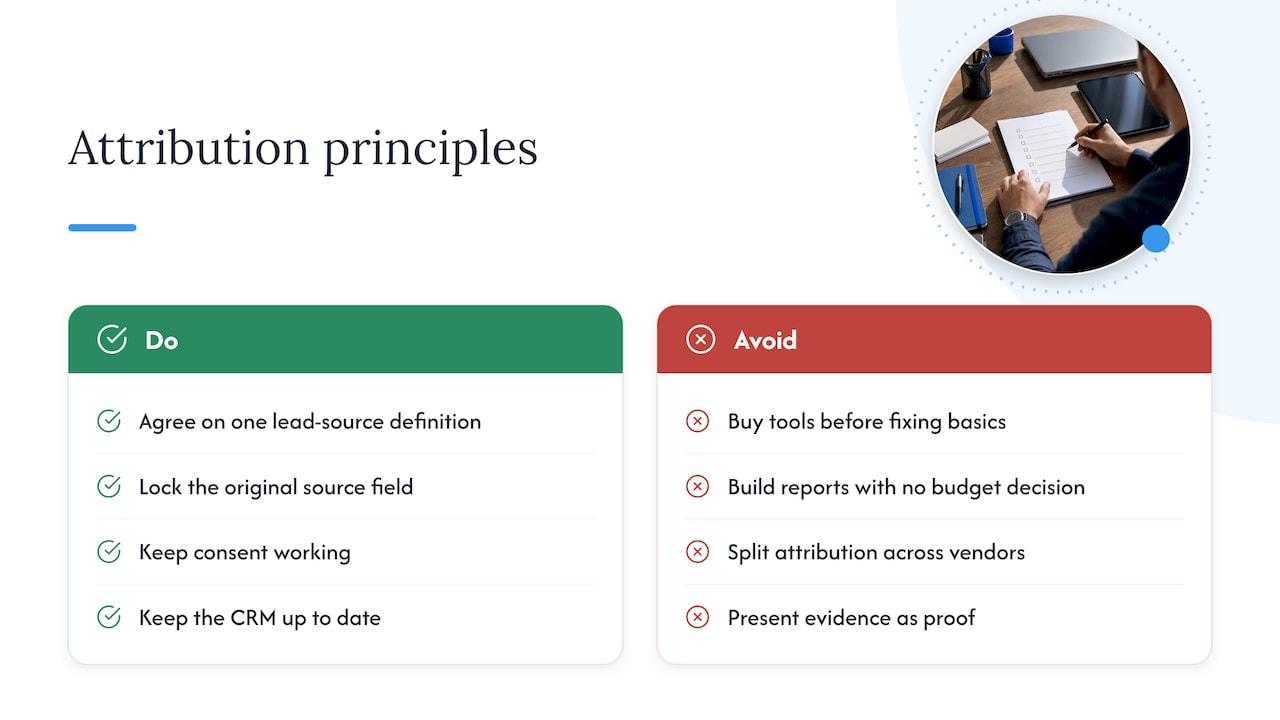
We also think attribution suffers when it is split across vendors. The media buyer owns the ad platform, the web developer owns the tags, someone else owns the CRM, and nobody owns the join between them. That join is where most data is lost. Keeping strategy, performance marketing, web development and CRM under one team means one person can trace a lead from the click, through the form and consent banner, into the CRM and back to the platform. That is the reason we work as an integrated team.
And we are honest about limits. No model will show you the whole dark funnel. We combine tracked data, CRM outcomes and what buyers tell you, and we present each as what it is: evidence, not proof.
— Alex
A 30-day plan to get started
Week 1: audit. Export your last 200 leads. How many have a lead source? How many have a campaign? How many carry a click ID? The blanks tell you where to start.
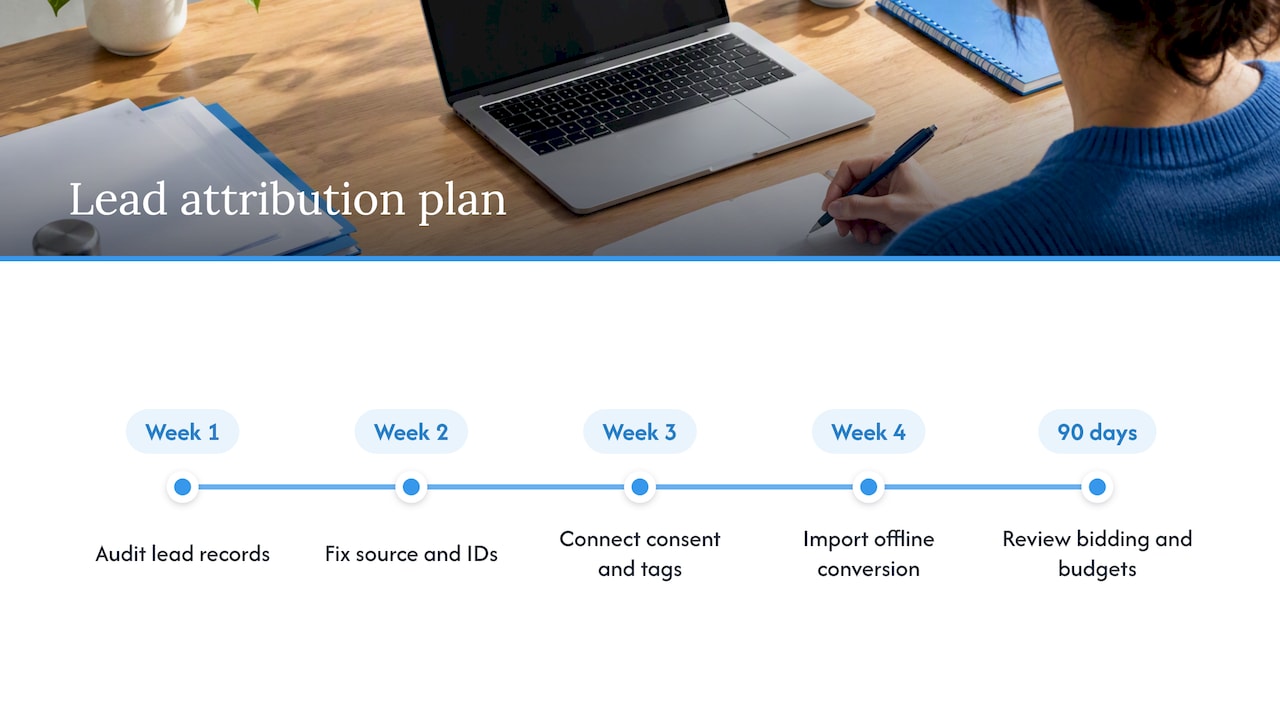
Week 2: fix capture. Standardize UTM naming, add hidden click ID fields and the self-reported question to your forms, and lock the original lead source field.
Week 3: connect consent and tags. Check that your consent banner and Consent Mode pass choices correctly, and test form submissions in both accepted and declined states.
Week 4: send the first offline conversions. Pick one stage, such as sales-qualified lead, and import it into your main ad platform. Build a simple report showing pipeline by original lead source, next to the self-reported view.
After 90 days, you will have enough data to decide whether to move bidding to deeper stages and which channels deserve more budget. For the wider picture, our article on measured full funnel marketing shows how attribution fits into planning.
Where we can help
If you would rather not coordinate this across several vendors, we can set up the full chain for you: strategy, tracking and attribution, paid media, CRM management and the website changes behind it. See our services or start from Vertical Brands to talk to the team about your pipeline reporting.
FAQ
What is the difference between lead source and campaign?
Lead source is the high-level origin of a lead, such as Google Ads or referral, and it should not change once set. Campaign is the specific initiative that prompted the conversion, such as a named webinar or ad set. Keeping them separate lets you compare channels over time and still analyze individual initiatives.
How does offline conversion tracking work for B2B leads?
You capture a click ID and form details when the lead arrives, store them in your CRM, and later upload outcomes such as qualified or closed-won back to the ad platform. The platform matches them to the original click. Where first-party data is used, it must be normalized and hashed, and you need valid consent.
Is B2B lead attribution possible under UK privacy rules?
Yes, but it needs a working consent framework. Google’s guidance says consent must be managed properly for enhanced conversions to be used, and declined cookies will leave gaps that Consent Mode can only partly model. For a view on your own lawful basis, ask your data protection officer or a UK data protection solicitor.
Why does my CRM show leads as direct traffic?
Usually because links are untagged, consent was declined, or the buyer researched elsewhere, for example in a peer group or an AI assistant, before visiting. Tag every link you control and add a self-reported source field. Together these recover much of what tracking alone misses.
Sources
- Salesforce Ben: Lead Source vs. Campaign
- LeadCenter: Sources vs. Campaigns hierarchy
- Think with Google: How Paylocity unlocked high-value B2B leads
- Google Ads Help: Enhanced conversions best practices
- Prospeo: Dark Funnel
- Iliana AI: The Dark Funnel Explained
- Topic Intelligence: Agentic Commerce Is a B2B Problem First
- 6sense: Beyond MQLs, Michelle Urwin
Recommended

Other posts
























































Stay ahead with better decisions.
Get business insights today.
