Average UK E-commerce Customer Acquisition Cost: 2026 Guide
A low customer acquisition cost can still signal weak growth. Understanding the average customer acquisition cost e-commerce UK brands should compare means looking beyond a headline figure. Published benchmarks vary by sector, source and calculation method. Some count paid media alone; others includ...

A low customer acquisition cost can still signal weak growth. Understanding the average customer acquisition cost e-commerce UK brands should compare means looking beyond a headline figure. Published benchmarks vary by sector, source and calculation method. Some count paid media alone; others include the wider cost of acquiring new customers. Those figures can look comparable, but it often reflects a different calculation.
A benchmark is a reference point, not a target. A low CAC may conceal poor customer value or a long payback period, while a higher figure can make sense when customers return and spend more. The right measure depends on what you include and how your business earns value over time.
This guide explains how to interpret UK e-commerce CAC benchmarks, calculate a consistent figure from your own data and assess it alongside customer value and payback. You’ll also see practical ways to improve acquisition efficiency across paid channels, conversion and retention, so your next growth decision rests on more than a single number.
Key Takeaways
• Treat the average customer acquisition cost e-commerce UK benchmark as a comparison point, not a target for your business.
• Calculate CAC using eligible acquisition costs and new customers from the same reporting period.
• Record each benchmark’s source, date, market, sector, currency and calculation method before comparing it with your own figure.
• Set a consistent baseline before changing budgets, audiences or conversion journeys, then assess tests against qualified purchases and payback.
• Consider acquisition, conversion and retention together. Paid social, paid search, SEO and CRM can all inform a more joined-up growth plan.
What is the average customer acquisition cost for UK e-commerce?
Customer acquisition cost (CAC) is the acquisition expenditure assigned to a period divided by the number of newly acquired customers in that period. The result is only meaningful when the costs and customer count use the same scope and timeframe. For a foundational overview, see Customer Acquisition Cost (CAC) definition and calculation.
There isn’t one dependable average that applies to every UK e-commerce business. The available SERP extracts don’t establish a verified UK-wide figure, and figures drawn from other markets or business types aren’t direct substitutes. Before using any 2026 benchmark, establish its named source, publication date, currency and calculation method. Without that context, a precise-looking number can mislead.
For a concise explanation of how CAC connects to e-commerce growth, watch this video:
Why UK e-commerce CAC benchmarks vary
Start with the commercial model. Sector, average order value, gross margin and purchase frequency all shape how much a business can sensibly spend to win a customer. A higher order value doesn’t automatically justify higher CAC: margin and the likelihood of further purchases matter too. A brand with frequent repeat orders may have different economics from one selling infrequently purchased products.
Acquisition conditions matter as well. Channel mix, brand awareness and customer intent affect how much effort it takes to turn a prospect into a first-time buyer. Established brands may benefit from existing demand, while a newer business has less recognition to draw on. These factors changes what CAC a business can sustain, particularly as repeat-purchase behaviour develops.
What a published CAC average can and cannot tell you
Before comparing a published figure with your own, inspect its sample, geography, time period, currency and calculation scope. Check whether it covers UK e-commerce specifically, which sectors or business models it includes, and whether the calculation counts advertising alone or broader acquisition expenditure. A dataset labelled “average” may combine businesses with very different costs and customer profiles.
Use the figure to frame a question, not set a spending limit. An industry average describes the dataset behind it; it doesn’t establish the profitable ceiling for an individual brand. That depends on its margins, repeat purchases and the value customers generate over time. CAC benchmarks are directional, not universal targets. Treat the average customer acquisition cost e-commerce UK figures you encounter as context, then test their relevance against your own business model.
How to calculate e-commerce CAC consistently
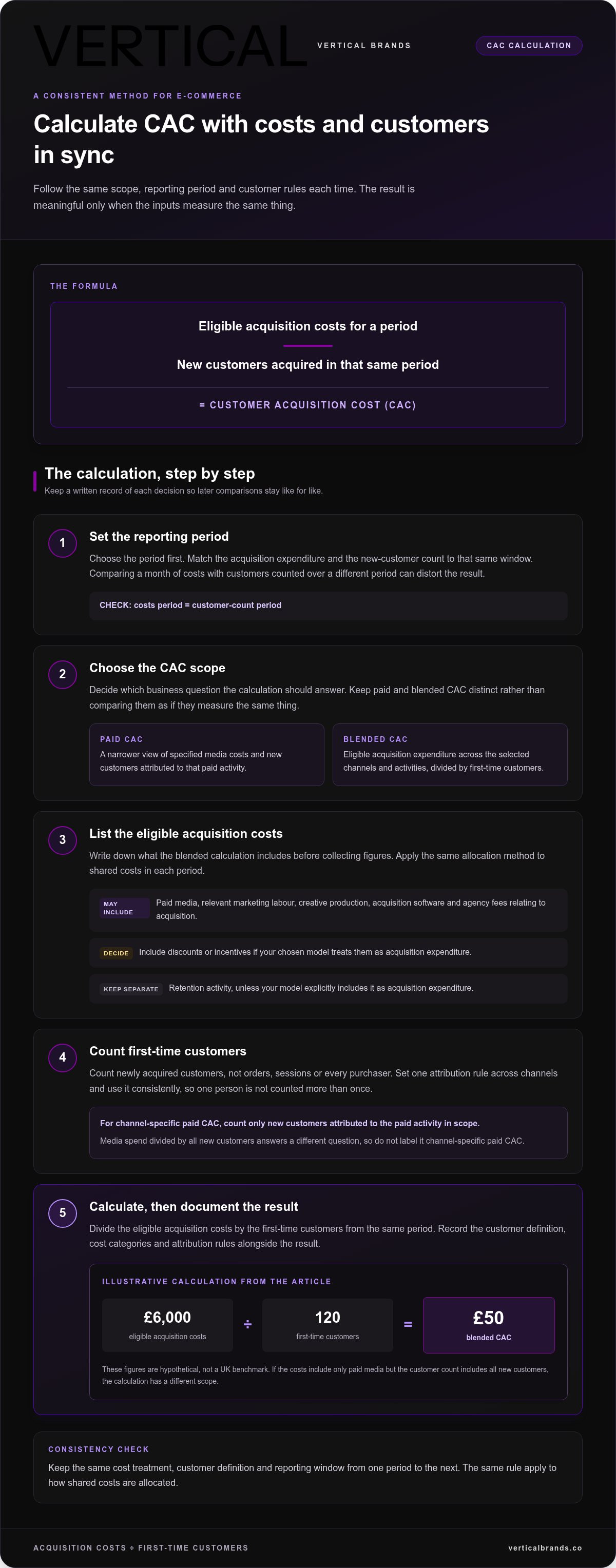
Use one formula and keep its inputs consistent: eligible acquisition costs for a period ÷ new customers acquired in that period = CAC. Define the reporting period first, then make sure the costs and customer count cover the same window. Comparing a month of expenditure with customers acquired over a different period can distort the result.
Choose the calculation that answers your business question. Paid CAC isolates the cost of specific media activity. A fully loaded blended CAC includes the wider acquisition costs you’ve decided to count. Keep both if useful, but don’t compare them as though they measure the same thing.
Which costs belong in a blended CAC calculation?
Write down what your blended calculation includes before gathering the figures. Eligible costs may include paid media, the relevant share of marketing labour, creative production and acquisition software. Allocate shared costs using a consistent method, and include agency fees where they relate to acquisition activity.
• Include discounts or incentives if your chosen model treats them as acquisition expenditure.
• Apply the same treatment to agency fees and shared team or software costs each period.
• Keep retention activity separate unless your model explicitly includes it as acquisition expenditure.
Consistency matters more than choosing the broadest possible cost list. If you include retention expenditure in one period but exclude it in another, the figures won’t provide a reliable comparison. The same rule apply to changes in how shared costs are allocated.
How to count new customers and align reporting periods
Count first-time customers, not orders, sessions or every purchaser. Set a clear attribution rule for deciding which activity receives credit, then use it consistently across channels. Where a customer interacts with several channels, apply one agreed approach to avoid counting that person more than once in the total.
Blended CAC is eligible acquisition expenditure across the selected channels and activities divided by the first-time customers acquired in the same period. Paid CAC uses a narrower cost and customer scope: specify the media costs included and count only new customers attributed to that paid activity. Don’t label media spend divided by all new customers as channel-specific paid CAC.
For example, an explicitly illustrative calculation could use £6,000 in eligible acquisition costs and 120 first-time customers from the same reporting period. The resulting blended CAC is £50. These figures are hypothetical, not a UK benchmark. If the costs include only paid media and the denominator includes all new customers, the result would answer a different question.
Document the period, cost categories, attribution rules and customer definition beside each result. That record helps your team compare like with like and interpret changes before adjusting channel investment. For support bringing channel measurement into integrated growth planning, keep acquisition costs and customer counts aligned from the outset.
How to compare CAC with UK benchmarks, customer value and payback
A benchmark only helps if it measures something comparable to your own CAC. A paid-media figure and a fully loaded blended figure answer different questions. The first focuses on the acquisition cost assigned to paid activity. The second includes the wider eligible acquisition expenditure defined by the business. Comparing them directly can make one approach look more efficient simply because it counts fewer costs.
Use a comparison record before drawing conclusions about the average customer acquisition cost e-commerce UK businesses may encounter. Capture the source details and calculation scope together, not just the headline figure.
| Comparison field | Benchmark A | Benchmark B |
|---|---|---|
| Source and publication date | Record the named source and date | Record the named source and date |
| Market and sector | Specify geography and product category | Specify geography and product category |
| Currency | Record the reported currency | Record the reported currency |
| CAC definition | State costs included and customer denominator | State costs included and customer denominator |
If a source doesn’t disclose one of these fields, mark it as unavailable. Don’t fill gaps with assumptions. A figure with unclear geography, sector or calculation scope may still offer background, but it shouldn’t be treated as a like-for-like benchmark.
CAC, customer lifetime value and contribution
Customer lifetime value (LTV) can describe revenue across a customer relationship, but revenue isn’t the same as the value left after product and fulfilment costs. For a more useful comparison with CAC, assess customer contribution after the relevant variable costs. Base future value assumptions on observed customer cohorts and purchase behaviour, rather than assuming every new buyer will repeat at the same rate.
Payback is the time required for a customer’s contribution to cover the acquisition cost. A lower CAC can still be a poor result if customer quality or contribution falls. Equally, a higher CAC may be supportable if observed customer contribution recovers it within a timeframe the business can sustain. The right interpretation depends on cash flow, margins and actual repeat purchases.
A practical UK benchmark comparison framework
Compare figures only when geography, sector, channel scope, time period and currency are compatible. Check whether each source measures paid CAC or blended CAC, and whether its denominator is first-time customers. If the definitions differ, keep the figures separate rather than adjusting them using an unsupported assumption.
Benchmarks change as market conditions and datasets change. Date every sourced figure, then verify that its publication and methodology are relevant for 2026 before using it in a decision. These checks prevents a broad industry average from becoming a misleading budget target. Use it to frame questions about your own customer contribution and payback, not to set a universal limit.
How to improve e-commerce CAC without weakening customer quality
Lower CAC is useful only if new customers still contribute to the business. Start with a consistent baseline before changing budgets, audiences or conversion journeys. Record the same cost scope, first-purchase definition and reporting window each time, then assess performance against qualified first purchases, contribution and payback. Without that baseline, it’s difficult to tell whether a change improved efficiency or simply changed how results are counted.
Prioritise tests by their likely commercial effect. A cheaper click isn’t the objective. Focus on changes that could attract more suitable first-time buyers, improve their path to purchase or support stronger contribution after the sale. Review conversion rate separately from media cost: conversion can improve while cost per click stays steady, or media costs can fall without generating more valuable customers.
Reduce friction across acquisition and conversion
Check that each landing page reflects the promise made in its advert or search result. Clear product information and a straightforward checkout help customers make an informed purchase. Treat these as connected parts of the journey, not isolated fixes. Test one meaningful variable at a time, such as creative, audience or landing-page content, so the team can identify what changed performance.
Assess paid social and paid search against first-time customers, not platform-reported conversions alone. Platforms can attribute activity differently, so reconcile their reporting with your own customer records and agreed attribution rules. If paid-media efficiency needs deeper treatment, explore this guide to improving e-commerce ROAS in a high-CAC market.
Use retention and channel mix to assess customer quality
Follow newly acquired customer groups after the first order. Compare repeat purchasing and contribution over a consistent period. A campaign may appear efficient at acquisition but bring in customers who buy once and generate limited contribution. These results needs time to emerge, so avoid judging customer quality from the first transaction alone.
Email and CRM activity can help you understand what happens after that first purchase. Track whether acquired customers return, how their contribution develops and how those patterns differ by acquisition source. This brings retention into the CAC assessment without treating every later purchase as proof that the initial campaign caused it. For wider context, see these customer retention marketing strategies.
Bring acquisition and retention evidence into one review. Keep channel costs, first purchases, repeat behaviour and contribution visible together, then prioritise the next test based on what the cohort are actually doing. Vertical Brands connects paid social, paid search, SEO and CRM within growth planning. If you’re ready to make CAC decisions using a joined-up view of acquisition and customer value, review your growth measurement approach.
How an integrated growth strategy makes CAC more useful
CAC becomes more useful when it informs decisions across acquisition, conversion and retention, rather than sitting alone in a performance report. A channel can appear efficient on first-purchase cost but deliver customers with weaker repeat behaviour. Another may have a higher initial CAC yet contribute more over time. Read the metric alongside customer contribution, payback and cohort quality before changing investment.
The average customer acquisition cost e-commerce UK businesses see in a report is only one reference point. Your own data needs to connect channel activity with who buys, what they contribute and whether they return. That joined-up view helps teams distinguish a genuine commercial improvement from a change in attribution or reporting.
Coordinate acquisition channels with customer data
Use a consistent definition of a new customer across paid social, paid search, SEO and CRM reporting. The same customer definitions also makes channel comparisons clearer, because teams can separate first-time buyers from existing customers and avoid inflating acquisition totals.
CRM insight can inform which audiences, products and messages deserve further testing. Klaviyo email marketing and CRM management help organise customer data and communications after a purchase. That insight can shape acquisition planning, but it doesn’t automatically reduce CAC. Website development also matters: the experience customers encounter after clicking a search result or advert influences whether interest becomes an order.
Turn CAC measurement into an operating decision
Set a regular review that brings together CAC, contribution, payback and cohort quality. Use the discussion to identify the decision, not just report the result: maintain a channel, investigate a conversion issue, or test a different route to qualified demand. Growth advisory can help align channel priorities with commercial goals, while paid media, SEO, website experience and CRM activity are considered as connected parts of the plan.
• Compare acquisition sources using the same customer definition and reporting scope.
• Review first-order contribution alongside subsequent cohort behaviour.
• Record the decision made and the evidence that will inform the next review.
This discipline gives teams a stronger basis for allocating resources without treating a benchmark as a prescribed target. For a wider view of how priorities shift as a business develops, explore the e-commerce growth stages framework.
Vertical Brands brings paid social, paid search, SEO, Klaviyo management, website development and growth advisory into growth planning. The aim is to make measurement and channel decisions part of one operating view, without assuming that one tactic will produce a particular result. If you’re ready to connect CAC measurement with your wider commercial priorities, explore Vertical Brands’ growth services.
Make your next CAC decision more deliberate
Turn CAC from a reporting figure into a decision you revisit with purpose. Set a regular review, identify the commercial question you need to answer, then choose a test that can inform it. Record the expected effect and the signals that would change your decision. That makes it easier to distinguish a useful learning from a short-term fluctuation.
The average customer acquisition cost e-commerce UK brands encounter can provide context, but your next move should be shaped by your own customer behaviour and commercial priorities. Keep the measurement framework steady as your channel mix develops. The evidence from each cohort help show whether an acquisition approach is bringing in customers who support sustainable growth.
When you’re ready to align acquisition, customer experience and retention around clearer growth priorities, explore Vertical Brands’ integrated growth services. A more disciplined view of CAC gives your team a stronger foundation for deciding what to test next.
Frequently Asked Questions
What is the average customer acquisition cost for e-commerce in the UK?
There isn’t a dependable single figure that represents the average customer acquisition cost e-commerce UK businesses should expect. Published numbers may cover different countries, sectors, channels and cost definitions. Before using one, check the original source and confirm its date, currency, market and calculation scope. If those details are missing, treat the figure as background context, not as a target for setting budgets or judging performance.
How do you calculate customer acquisition cost for an e-commerce business?
Divide the acquisition expenditure you’ve chosen to include by the number of new customers acquired within the matching period. For example, if you’re reviewing a campaign, make sure the customer count refers to first-time buyers attributed under the same reporting rules, not all orders placed during that time. Keep a written record of the period and attribution approach so a later comparison uses the same basis.
What costs should be included in e-commerce CAC?
Include costs that relate to acquiring new customers, such as relevant media spend, marketing labour, creative production, acquisition software and applicable agency fees. Decide how to allocate shared costs, such as a team member’s time supporting several channels, then apply that method consistently. If discounts or incentives form part of your chosen model, document their treatment too. Clear records make it easier to explain what the figure includes.
What is the difference between paid CAC and blended CAC?
Paid CAC focuses on a defined paid channel or set of paid channels, using the media costs and new customers assigned to that activity. Blended CAC uses the broader acquisition costs included in your model and the corresponding new-customer total across its scope. A paid search report, for instance, shouldn’t be compared directly with a blended business-wide result unless their included costs and customer counts match.
Is a lower customer acquisition cost always better?
No. A lower figure can come with weaker customer quality, lower order contribution or fewer repeat purchases. For instance, discount-led activity might attract first-time buyers but contribute less after the discount is applied. Assess acquisition efficiency alongside customer contribution and subsequent purchasing behaviour. The same rule applies when comparing audiences: lower initial costs don’t prove that a group is more valuable to the business over time.
How should an e-commerce business compare CAC with customer lifetime value?
Compare CAC with the value customers generate over a defined period, and distinguish revenue from contribution after relevant product and fulfilment costs. Use observed customer groups and their actual purchasing patterns to inform the comparison. If a new cohort has not had enough time to show repeat behaviour, label its value as provisional rather than treating a forecast as established performance. This keeps the assessment grounded in evidence.
How often should a UK e-commerce business review its CAC?
Review CAC on a regular reporting cycle that suits your sales volume and decision-making pace, then revisit it when a material change affects acquisition or measurement. That could include a new channel, a budget shift or a change to attribution rules. Avoid reacting to a short-lived movement in isolation. Consistent records lets the team distinguish a genuine trend from a temporary fluctuation or a change in how results are counted.

Other posts































































Stay ahead with better decisions.
Get business insights today.
