Brand Entity SEO: 7 Steps to Build a Knowledge Graph AI Can Cite

Brand entity SEO means optimizing your brand as a distinct, verifiable entity so search engines and AI systems recognize it as a single trustworthy node rather than a loose cluster of pages and keywords. The payoff is clearer representation in Google’s Knowledge Graph and a better chance of being cited directly in AI-generated answers. The first move is simple: pick one canonical brand identity and make sure your homepage and about page both point to it consistently.
TL;DR:
- Map your organization, products, and named people to one canonical URL each, then align page titles, headings, descriptions, and identifiers.
- Add Organization and WebSite structured data with consistent @id and sameAs links, render it on the server, and validate each deployment.
- Build content clusters around entities, link supporting pages to canonical entity pages, and standardize brand naming across social profiles, directories, and press references.
- Track Knowledge Panel presence, direct AI citations, verified external profiles, and internal links weekly alongside Search Console data; conventional rank trackers miss these signals.
- Keep keyword optimization for transactional searches, but prioritize entity work when recognition, trust, or visibility beyond targeted phrases matters more.
Table of Contents
- What Is Entity SEO and How Does It Differ From Keyword SEO
- How Google’s Knowledge Graph and AI Systems Use Entity Relationships
- Why Brand Entity SEO Matters for Visibility and Authority
- How to Build a Brand Knowledge Graph Step by Step
- Which Schema Types and JSON-LD Properties You Need
- Tools and Metrics for Tracking Entity Visibility
- Common Entity SEO Mistakes and How to Fix Them
- A Repeatable Entity SEO Checklist for Teams
- How Vertical Applies Entity-First Tactics in Practice
- Entity SEO Will Keep Compounding, Not Fading
- Let Us Build Your Brand’s Entity Foundation
- FAQ
- Sources
What Is Entity SEO and How Does It Differ From Keyword SEO
Keyword SEO targets exact phrases. Entity SEO targets concepts, organizations, people, and products, and the relationships between them, which gives your brand visibility across every query connected to that concept rather than just the ones matching a specific string. According to Ahrefs’ glossary definition, brand entity SEO focuses on optimizing for distinct entities so search engines and AI systems can correctly identify and link your brand within the Knowledge Graph, and this differs from keyword SEO precisely because it targets concepts and relationships instead of exact-match phrases.
This distinction matters because entities carry meaning across contexts. A keyword strategy might rank you for “best running shoes,” but an entity strategy makes your brand recognizable whenever anyone, or any AI model, references running shoe brands, athletic retailers, or specific product lines you own.
Common entity types include:
- Organizations: your company as a registered, named business
- People: founders, executives, or named experts tied to your brand
- Products: individual items or services with their own identifiable attributes
- Concepts: ideas, methodologies, or categories your brand is associated with
When these entities are clearly defined and connected, search engines and AI tools can surface your brand across a wider set of related queries, not just the ones you directly optimized for.
How Google’s Knowledge Graph and AI Systems Use Entity Relationships
Google’s Knowledge Graph works as a network of nodes and edges: each node represents an entity, and each edge represents a verified relationship between two entities, like “Vertical Brands” connected to “growth marketing agency” or to a named client. The stronger and more consistent those connections, the more confidently Google can place your brand correctly in that network.
Several signal types feed this graph:
- Structured data: schema markup that explicitly labels who you are and what you do
- sameAs links: connections to your verified profiles on other authoritative sites
- Trusted third-party references: mentions, citations, and listings on sites Google already trusts
AI systems draw on similar logic. According to Semrush’s entity-based SEO research, large language models and AI systems are more likely to cite brands and content that present clear entity signals and authoritative connections, both in their training sources and in the Knowledge Graph. In practice, this means a brand with a disambiguated, well-connected entity profile is more likely to show up by name in an AI-generated summary than a brand that relies purely on keyword density.
Why Brand Entity SEO Matters for Visibility and Authority
Entity clarity compounds. Every schema update, every consistent sameAs link, and every well-mapped content cluster adds another confirmed signal to the graph, and those signals reinforce each other over time rather than resetting with each new piece of content. That compounding effect is the main reason entity work outperforms one-off keyword wins over a 12-month horizon.
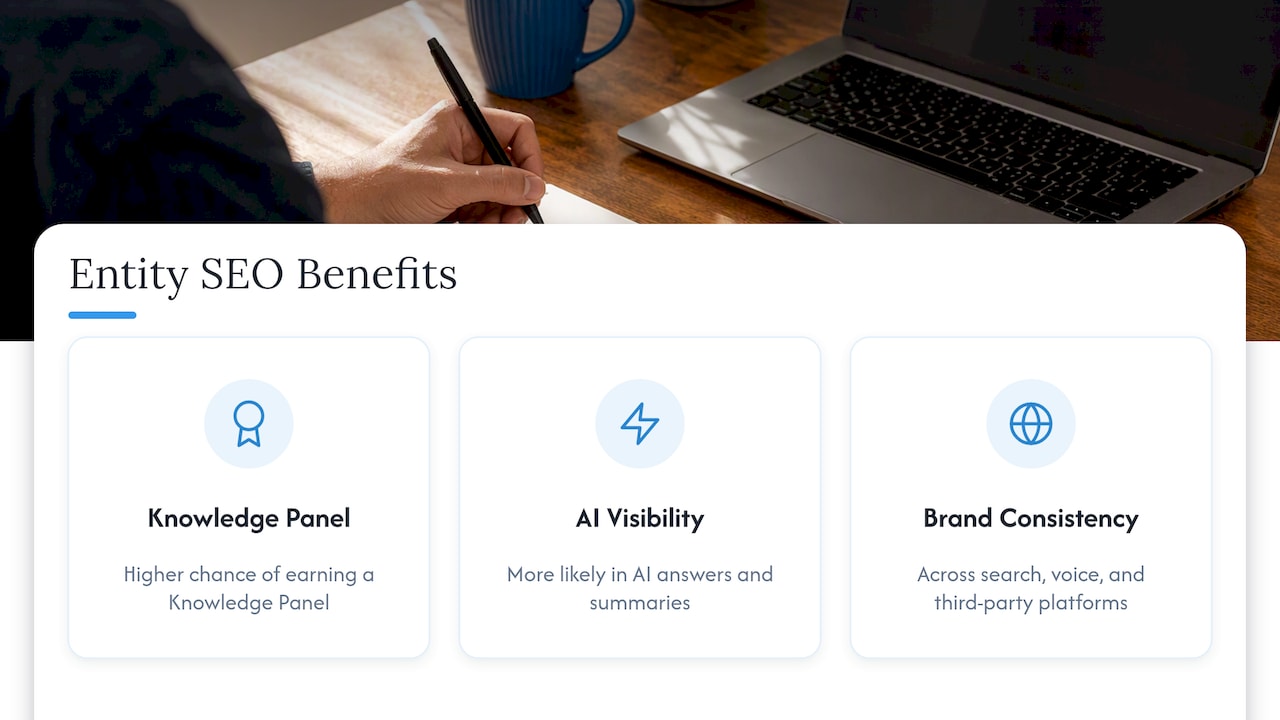
The practical benefits stack up in three areas: a higher chance of earning a Knowledge Panel, a stronger likelihood of appearing in AI-generated answers and summaries, and more consistent brand representation across search, voice assistants, and third-party platforms. For teams deciding where to spend limited resources, entity work deserves priority whenever brand recognition, trust, or AI visibility matters more than ranking for a single transactional phrase. Keyword optimization still has its place for capturing specific purchase intent, but entity clarity is the layer that determines whether your brand is recognized at all once a query moves outside your targeted keyword list.
How to Build a Brand Knowledge Graph Step by Step
Building a brand knowledge graph is a sequence, not a single project. Each step strengthens the one before it, and skipping steps tends to produce inconsistent signals that confuse rather than clarify.
- Map your entities and select canonical identifiers. List every entity tied to your brand, organization, products, named people, and where possible, attach external identifiers like Wikidata QIDs to anchor them to a recognized reference point.
- Designate entity home pages. Choose one canonical URL per entity and align its title tag, H1, and meta description so they all describe the same entity the same way.
- Implement Organization and WebSite schema. Add structured data with sameAs links and a consistent @id so search engines can tie every mention back to one verified source.
- Build entity-centered content clusters. Group content around the entity itself, not around keyword variations, so every related article reinforces the same concept.
- Reinforce relationships with internal linking. Link supporting pages back to the entity home page using descriptive anchor text, which signals which page is authoritative for that entity. Our internal linking strategy guide covers templates for this.
- Acquire and standardize external references. Pursue profiles, directories, press mentions, and Wikipedia or Wikidata entries where relevant, keeping the brand name and description identical everywhere it appears.
- QA before rollout. Confirm structured data renders server-side, validate it with Google’s testing tools, and check staging environments before pushing live.
Search Engine Land’s entity-first optimization guide recommends that every page point to one canonical entity using schema like mainEntityOfPage, with content clusters organized around entities rather than keyword volume. The guide also suggests operationalizing this by embedding entity checks directly into content production: writers select a canonical entity before drafting, developers deploy matched JSON-LD, and analysts report on entity-level visibility rather than keyword rankings alone.
Pro Tip: Run entity extraction on your top-performing URLs using tools like Google’s NLP API, Diffbot, or OpenAI embeddings to catch semantic drift early and realign headings, schema, and inline references before it affects how AI systems interpret your content.
Developers managing ecommerce catalogs will find additional detail in our guide to server-rendered schema for ecommerce, which covers the same principles applied to product-level entities.
Which Schema Types and JSON-LD Properties You Need
Schema markup gives search engines a structured, unambiguous description of your entities, and the right types depend on what you’re describing. Organization schema belongs on your homepage or about page. WebSite schema helps search engines understand your site structure. Person schema applies to named founders or experts. Product schema applies to individual items you sell.
A handful of properties do most of the disambiguation work:
- @id: a unique identifier that ties every mention of the entity back to one canonical record
- sameAs: links to verified external profiles, such as social accounts or Wikidata entries
- mainEntityOfPage: confirms which entity a given page is primarily about
- url and logo: basic identifying properties that reinforce brand recognition in search results
Google’s own documentation on Organization structured data recommends adding as many relevant Organization properties as apply and placing them on the homepage or an about page, since sameAs links and official profiles help Google aggregate signals from multiple sources into one knowledge panel. Structured data should render server-side rather than relying on client-side JavaScript, since not every crawler executes scripts the same way, and every deployment should be validated with structured-data testing tools before going live.
Tools and Metrics for Tracking Entity Visibility
Measuring entity SEO requires a different dashboard than traditional keyword tracking, since the goal is recognition and citation rather than ranking position alone. Useful tools include the Knowledge Graph Search API for checking how Google currently represents your entity, Google Search Console for indexing and query data, Semrush’s AI visibility tracking, and dedicated entity trackers that monitor mentions across AI platforms.
Track these metrics on a regular cadence:
- Knowledge Panel presence: whether your brand triggers a panel and how complete it is
- Authoritative sameAs references: the count and quality of verified external profiles linked to your entity
- AI citation incidents: how often your brand is named directly in AI-generated summaries
- Internal link counts: how many pages reinforce your entity home pages
According to Search Engine Land’s Knowledge Graph guide, monitoring entity signals requires both standard SEO tools and entity-aware tracking, since Knowledge Graph presence and AI citation behavior don’t show up in conventional rank trackers. A weekly dashboard that combines Search Console data with manual AI citation checks gives most teams enough signal to spot meaningful movement without over-investing in specialized software. For a deeper look at fixing rendering issues that block AI visibility, our AI search visibility guide walks through a practical audit process.
Common Entity SEO Mistakes and How to Fix Them
Most entity SEO failures trace back to inconsistency rather than a lack of effort. Moz’s Whiteboard Friday on brand entity SEO points out that inconsistent naming, casing, and spacing confuse natural language processing systems and weaken entity signals, which is why an internal naming audit is often the highest-leverage first fix.
Watch for these recurring issues:
- Inconsistent brand naming across your website, social profiles, and directory listings
- Missing sameAs links or mismatched @id values that leave your entity disconnected from its verified profiles
- Weak internal linking that leaves pages siloed instead of reinforcing entity relationships
- Over-reliance on keyword optimization while entity clarity gets ignored entirely
Each of these has a fast fix: standardize your brand name in one document and apply it everywhere, audit your schema for missing properties, add contextual internal links between related pages, and treat entity mapping as a parallel workstream to keyword research rather than an afterthought.
A Repeatable Entity SEO Checklist for Teams
Consistency scales better than cleverness here. Establish one canonical brand name and register it identically across every profile, directory, and legal document you control. Make schema part of your standard editorial and deploy workflow instead of a one-time technical project. Report progress using entity-level metrics such as Knowledge Panel presence and AI citation counts, not just keyword rankings. Blend PR, partnerships, and content so that external links accumulate naturally around your canonical entity rather than looking engineered.
- Register one canonical brand name everywhere, from social bios to legal filings
- Build schema checks into your content and development workflow
- Track entity-level metrics alongside, not instead of, keyword performance
- Pair PR and partnership outreach with content to build authoritative external references
| Practice | What it fixes | Who owns it |
|---|---|---|
| Canonical naming audit | Inconsistent brand mentions across platforms | Marketing lead |
| Schema in deploy workflow | Missing or outdated structured data | Development team |
| Entity-level reporting | Blind spots in AI and Knowledge Graph visibility | Analytics team |
| PR and partnership outreach | Weak external authority signals | Communications team |
How Vertical Applies Entity-First Tactics in Practice
We run as an integrated growth marketing agency, combining strategy, creative, performance marketing, and web development under one roof specifically so entity work doesn’t get lost between disconnected vendors. When schema, content, and paid media sit with separate teams, canonical naming and structured data tend to drift out of sync, which is the exact problem entity SEO is meant to solve.
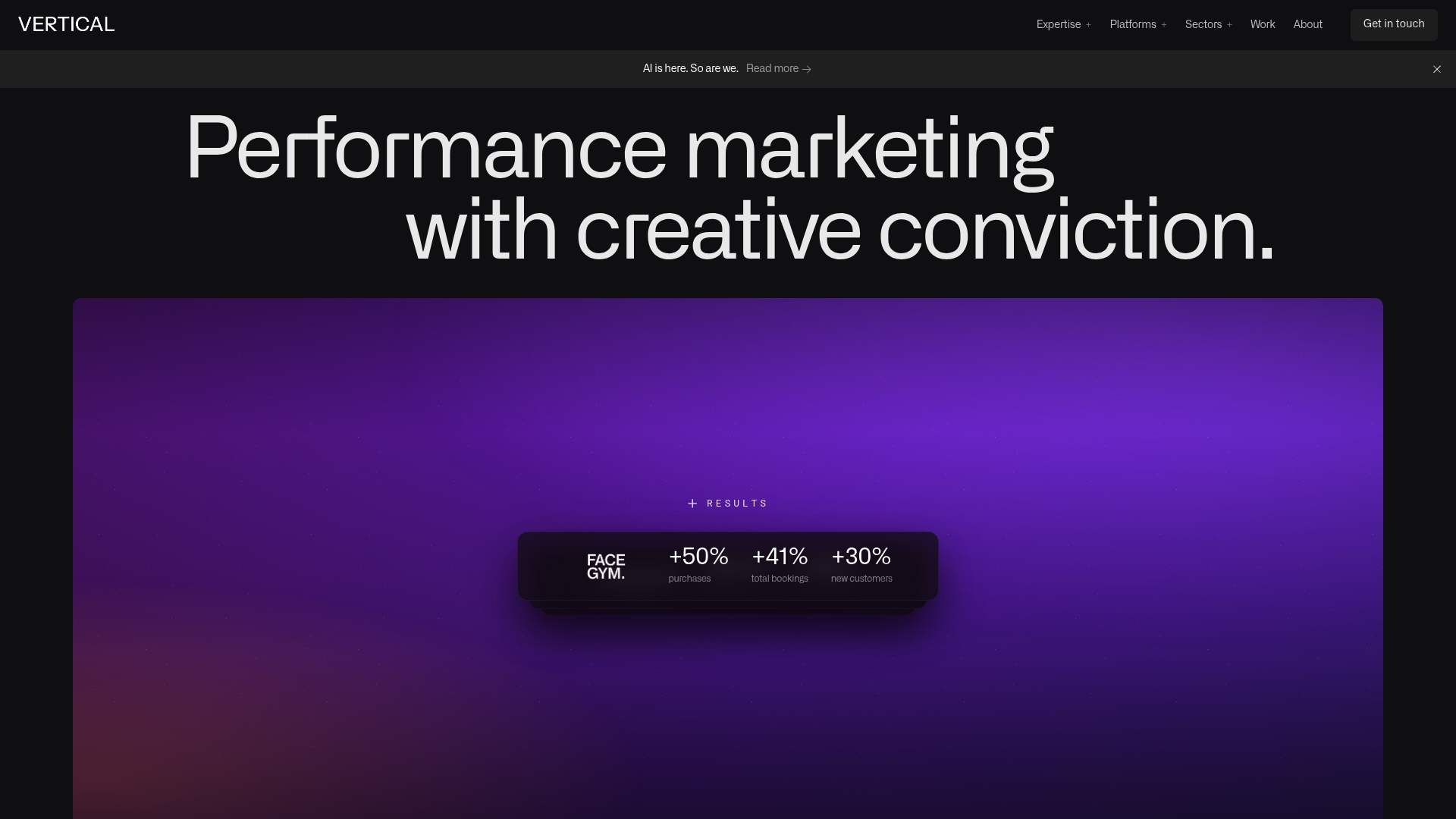
Our work with FACEGYM reflects what integrated execution can produce: a 50% increase in purchases and a 41% rise in bookings after we aligned their digital strategy and execution across channels.
Clear entity signals only hold up when strategy, content, and development move together instead of in separate sprints.
Our cross-discipline teams handle entity mapping, schema rollout, and measurement as one continuous workflow rather than three separate handoffs, which keeps canonical identifiers consistent from the first content brief through final deployment.
Entity SEO Will Keep Compounding, Not Fading
Entity work rewards whoever starts first, because every verified signal makes the next one easier to establish and harder for competitors to displace. Brands that treat this as a one-time project will keep losing ground to brands that treat it as ongoing infrastructure. If you do one thing in the next 90 days, audit your canonical name and sameAs links across every platform you control. That single pass tends to surface the most damage and the fastest wins.
— Alex
Let Us Build Your Brand’s Entity Foundation
Turning everything above into a working knowledge graph takes coordination across strategy, content, schema, and measurement, which is exactly where most in-house teams run out of hours. We bring brand strategy, technical SEO, and development together so canonical naming, schema implementation, and content clusters launch as one coordinated plan instead of three disconnected projects.
- Define your canonical brand entity and audit existing naming inconsistencies
- Implement and validate Organization and Product schema across your site
- Build entity-centered content clusters with reinforced internal linking
- Track Knowledge Panel presence and AI citation trends on an ongoing basis
Our full service catalogue covers each of these disciplines under one engagement. Reach out through our site to request a diagnostic review of your current entity signals and find out where the gaps sit.
FAQ
What is entity-based SEO and how does it work?
Entity-based SEO optimizes for distinct, identifiable entities such as organizations, people, products, and concepts so search engines and AI systems can correctly connect and cite your brand. It works through structured data, consistent naming, and authoritative external references that confirm the same entity across every source, as outlined in Ahrefs’ entity SEO glossary.
Is SEO still worth investing in going forward?
SEO remains worth the investment because search and AI-driven discovery both depend on the same underlying signals: structured data, authoritative content, and clear entity recognition. Brand entity work in particular compounds over time, since each verified signal makes your brand easier to recognize and cite in future queries.
Should I choose PPC or SEO for my brand?
PPC and SEO serve different goals rather than competing directly: PPC delivers immediate visibility for specific terms, while SEO, especially entity SEO, builds lasting recognition that persists across queries you never directly targeted. Most brands benefit from running both, with entity SEO providing the foundation that makes paid campaigns more credible and recognizable.
Can a beginner realistically do entity SEO?
A beginner can start entity SEO by auditing brand name consistency and adding basic Organization schema, since both steps require no advanced technical skill. More advanced steps, like structured-data validation and entity extraction, benefit from developer support, so many teams combine in-house effort with outside expertise like our SEO services as the work scales.
How does entity SEO support local SEO and voice search?
Entity SEO strengthens local SEO and voice search because both rely on confirmed, disambiguated information about who you are and what you offer rather than keyword matching alone. Consistent sameAs links to local directories and Google Business Profile listings help confirm your entity for location-based and voice queries, and maintaining accurate local profiles through resources like TK Marketing’s guidance for trade businesses reinforces the same signals Google’s Knowledge Graph depends on.
Sources
- Ahrefs — Entity-based SEO (glossary)
- Search Engine Land — Entity-first content optimization
- Google Developers — Organization structured data
- Semrush — Entity-based SEO strategy
Recommended

Other posts



























































Stay ahead with better decisions.
Get business insights today.
