Supplement Brand Marketing Agency UK: A Growth Framework for 2026
More traffic won’t fix a growth system that loses customers after their first order. A supplement brand marketing agency UK businesses choose should connect positioning, acquisition and retention, rather than treat each channel as a separate task. When paid campaigns, the website experience and CRM...

More traffic won’t fix a growth system that loses customers after their first order. A supplement brand marketing agency UK businesses choose should connect positioning, acquisition and retention, rather than treat each channel as a separate task. When paid campaigns, the website experience and CRM activity pull in different directions, attention can rise without creating a dependable path to repeat purchase.
That disconnect is familiar. Acquisition, conversion and retention are often measured in separate dashboards, while category-specific education and product claims need clear, credible communication. The challenge isn’t simply to do more marketing. It’s to make every stage reinforce the next.
This guide sets out a practical framework for assessing an agency’s strategic and channel capabilities, and aligning paid social, paid search, SEO, website experience and Klaviyo email and CRM management. You’ll see how to judge what your brand needs now, where retention belongs in the growth plan, and how to build an approach that fits your commercial stage and resources. It also considers how useful content can support customer understanding without overpromising. One coherent system. Clear priorities. Better-informed decisions.
Key Takeaways
• Build supplement marketing around positioning, acquisition, conversion and retention, with clear product communication at every stage.
• Give paid social, paid search, SEO, website experience and CRM distinct roles, then connect them across the customer journey.
• When assessing a supplement brand marketing agency UK businesses can work with, look beyond specialist language to integration, measurement and operational clarity.
• Set priorities using your customers, offer, margins and channel context. A growth plan should fit your commercial stage, not a universal target.
• Use growth advisory to align paid media, SEO, website development and CRM, so channel activity supports a shared plan.
Why supplement brand marketing in the UK needs more than product promotion
Product promotion can earn attention. On its own, it can’t explain why a product might belong in someone’s routine, help them assess whether it suits their needs or give them a reason to return. Supplement brand marketing needs to coordinate positioning, customer acquisition, conversion and retention. Each activity should reinforce the same promise while giving customers useful information at the point they need it.
Connected supplement marketing coordinates brand positioning, acquisition, conversion and retention to create a consistent customer journey from first discovery to repeat purchase. That strategic view matters more than a collection of isolated tactics. A supplement brand marketing agency UK businesses assess should understand how each channel contributes to the journey, not just whether it can run a campaign.
For a practical view of the work involved in building a supplement business, watch this short video:
What makes supplement marketing different from generic e-commerce promotion?
A supplement purchase can involve more consideration than a straightforward repeat-buy item. Customers may want to understand an ingredient, how a product fits their routine and what information supports its stated value. Education should answer those questions clearly. It should distinguish established product information from assumptions, and avoid turning a possible benefit into a promised outcome.
Claims need careful handling. Before publishing product or advertising claims in the UK, check current Advertising Standards Authority guidance and the applicable CAP Code. Creative language can’t replace substantiation. Clear communication helps customers make informed choices and gives every channel a reliable foundation.
Where disconnected marketing creates friction
Imagine a customer sees an advert focused on a particular ingredient, then lands on a page led by a different message. A follow-up email that introduces yet another proposition adds friction. Each asset may be polished, but the journey feels disjointed. Consistent language and a clear progression from discovery to product detail make it easier for people to understand the offer.
Channel silos also weaken the business’s view of performance. Paid media may be judged on immediate sales, whilst SEO is assessed on visits and email on clicks. Those measures can be useful, but none alone shows how channels influence the overall customer journey. Understanding marketing strategy starts with connecting objectives, audience and execution, rather than treating each activity as an independent result.
Brand awareness and commercial outcomes are different measures, but both matter. Awareness can help a brand become recognisable; conversion and retention show how that recognition relates to purchasing behaviour. Customer lifetime value is a useful strategic lens for considering repeat purchasing over time, not a guaranteed result or a reason to ignore acquisition costs. The signals across these stages is most useful when reviewed together, with measures tied to the brand’s actual objectives.
How an integrated supplement marketing system connects discovery to repeat purchase
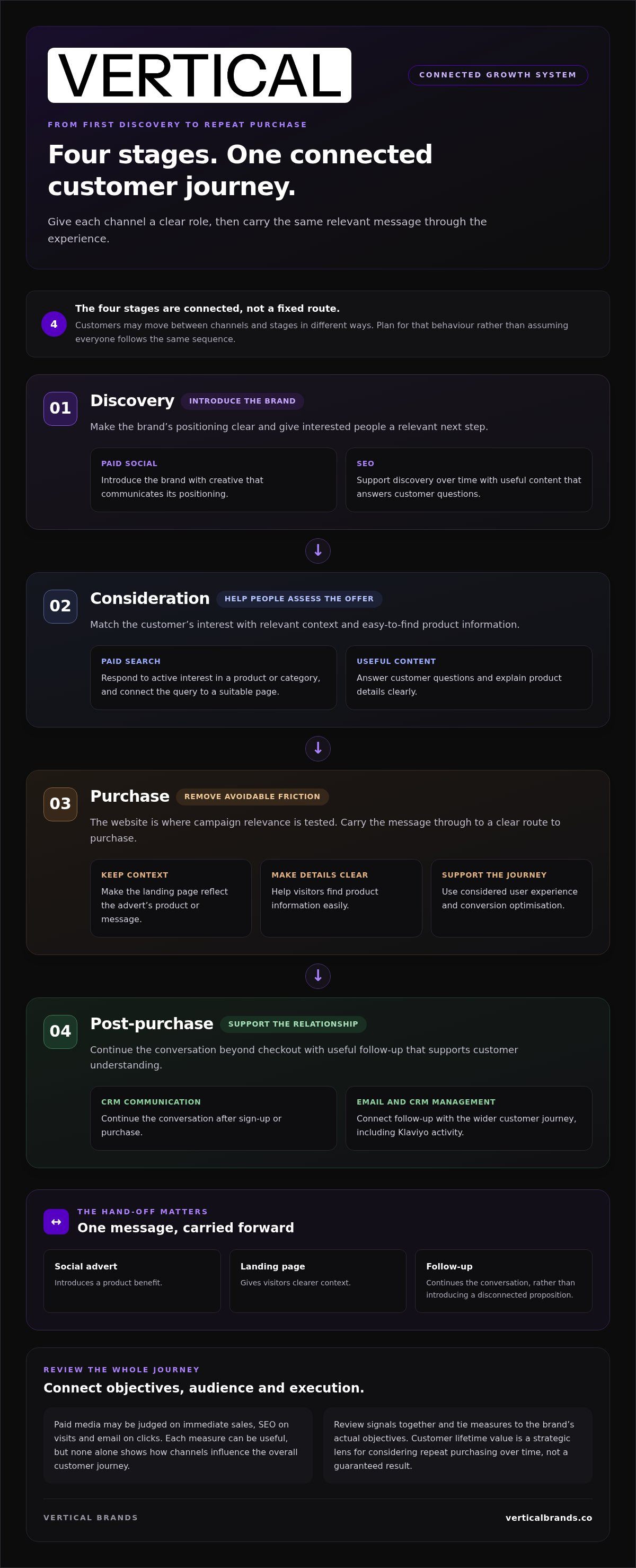
A customer journey rarely follows a neat, single-channel route. Someone may first notice a product through social content, return after a search, compare details on the website and purchase later. After the order, useful follow-up can support their understanding of the product and the brand. Planning these interactions as connected stages makes it easier to give each channel a clear job.
Start with four stages: discovery introduces the brand; consideration helps customers assess the offer; purchase removes avoidable friction; and post-purchase communication supports the relationship beyond checkout. The stages connect, but customers may move between them in different ways. Plan for that behaviour rather than assuming everyone follows the same sequence.
Match each channel to a specific customer-journey role
Paid social can introduce the brand through creative that communicates its positioning and directs interested audiences towards a relevant next step. Paid search can respond to active interest in a product or category, connecting the query to a suitable page. SEO supports discovery over time with useful content that answers customer questions and helps explain product details.
These roles should complement one another. For example, a social advert can introduce a product benefit, while its landing page gives visitors clearer context. Search content can address related questions, and CRM communication can continue the conversation after sign-up or purchase. A supplement brand marketing agency UK businesses assess should explain how channel choices fit together, not simply present a list of available platforms.
Connect the website and CRM to the purchase experience
The website is where campaign relevance is tested. If an advert promotes a particular product or message, its landing page should carry that context forward, make product information easy to find and give visitors a clear route to purchase. Website design and development can support this through considered user experience and conversion optimisation, rather than relying on more traffic to compensate for a confusing journey.
CRM extends the experience. Klaviyo can support automated welcome, educational and post-purchase emails, with content shaped around the customer’s stage and previous interactions. It is a platform within the system, not a growth strategy by itself. The strategy still needs to define the audience, message, timing and purpose of each communication. Teams planning a platform change can use a Klaviyo migration process guide to understand the operational work involved.
Measurement should connect channel activity to outcomes that matter to the business. Review how discovery contributes to qualified visits, whether relevant pages support conversion, and how post-purchase communication relates to repeat orders. No single metric tells the whole story. Shared reporting helps teams spot where a customer journey loses continuity and decide what to improve next.
For brands mapping these priorities across channels, connected growth advisory can bring acquisition, website experience and CRM into one plan.
How to assess a supplement brand marketing agency without buying a channel checklist
A proposal can name paid social, SEO, website development and CRM, yet still leave the central question unanswered: how will this work support your commercial priorities? Assess a supplement brand marketing agency UK businesses consider on the thinking that connects its capabilities, not the length of its channel list. Specialist language alone doesn’t prove commercial understanding or operational fit.
Use a simple comparison framework. Look for specific explanations of how the agency will understand your business, connect activity and make decisions, rather than broad promises or a catalogue of deliverables.
| Assessment area | What to look for |
|---|---|
| Category understanding | A willingness to understand your audience, product context and customer questions, without relying on jargon as a substitute for insight. |
| Channel integration | A clear relationship between creative, paid media, website experience, SEO and CRM, with each channel assigned a defined role. |
| Measurement | Success measures linked to your objectives, with clear definitions and reporting that distinguishes activity from business outcomes. |
| Operating clarity | Defined responsibilities, decision ownership, communication rhythms and a practical process for reviewing and adapting the plan. |
What evidence demonstrates strategic and operational fit?
Look for a diagnostic process that starts with commercial context, then explains why particular channel priorities follow. The reasoning should connect creative choices to paid activity, landing-page experience and CRM communication. A coherent strategy shows how those parts support one another; a disconnected proposal simply lists what will be produced or managed.
Look for clarity on what success means, how performance will be reported and who is responsible for decisions. The criteria aren’t the number of dashboards or meetings. The important question is whether reporting helps the team decide what to continue, change or stop. This makes accountability practical, rather than a promise made at the start and forgotten in delivery.
How should supplement claims and customer trust be handled?
Assess how the agency approaches product communication. Content planning should favour clear, substantiated information and explain the product without turning uncertain outcomes into promises. Before making specific advertising or product claims, writers should check current Advertising Standards Authority guidance and the applicable CAP Code. Don’t assume a message is acceptable simply because it appears in competitor marketing.
Credibility and conversion aren’t opposing goals. Clear product information can help customers understand the offer and make a considered decision. Ask how the strategy will keep messaging consistent across adverts, landing pages and follow-up, and how concerns about wording are raised before publication. A responsible process protects trust while keeping the customer journey commercially focused.
Use the framework to compare the quality of the thinking, not just the number of services offered. A strong fit connects your business priorities to coordinated activity, transparent measurement and clear ownership.
A practical growth-planning sequence for supplement brands
Growth planning should start with the business, not a preferred platform or a universal revenue target. A brand with strong demand but weak conversion has a different priority from one converting well but struggling to encourage repeat orders. Work through the sequence below to identify the constraint, select connected actions and decide how you’ll learn from them.
Set the commercial baseline before selecting channels
Clarify the objective, audience, offer and economics first. Review margin context alongside the customer journey, so marketing priorities account for what the business needs to sell and what it can sustainably support. Then map what is already known from performance reporting and CRM data. Record gaps too. If repeat-purchase tracking is incomplete, for example, treat retention conclusions with care rather than presenting them as certain.
Define the objective.
Set a commercial priority that fits the brand’s stage, such as improving the quality of demand, supporting conversion or strengthening repeat purchasing. Specify what progress would look like for this business, without borrowing an unrelated industry benchmark.
Map the customer and offer.
Identify the audience, the product’s role in their consideration and the questions they need answered. Check how the offer, product information and customer experience currently support that decision.
Diagnose the constraint.
Review available channel, website and CRM information together. Is discovery limited, are relevant visitors leaving before purchase, or is the post-purchase relationship underdeveloped? Note what the data can and cannot show.
Choose a connected priority.
Select a manageable set of actions based on the diagnosed constraint. If the landing page doesn’t continue the message used in an advert, for instance, align the creative and page before simply expanding channel activity. Each channel has a role within the plan, but not every channel needs to be activated at once.
Review and refine.
Agree how progress will be assessed, who owns decisions and when the team will review the evidence. Record what changed, what happened and what the next decision should be. This creates a learning loop, rather than a sequence of unrelated campaigns.
Sequence testing, learning and optimisation
Testing works best when it addresses a clear question. Prioritise based on the diagnosed constraint, not channel fashion. Coordinate the creative, landing-page experience and follow-up communication so each test examines a connected part of the customer journey. If a campaign changes its core message, for example, check that the page and subsequent CRM communication still make sense alongside it.
Use measures that match the objective. A discovery initiative may be assessed differently from a conversion improvement or a retention programme. Set the evaluation approach before activity begins, then review it consistently. Don’t claim success from a convenient metric if it doesn’t answer the commercial question.
This diagnosis-to-review sequence can also sit within a broader e-commerce growth stages framework, helping teams understand how priorities may change as the business develops. To build a connected plan around your commercial priorities, speak with Vertical Brands about growth advisory.
How Vertical Brands can support connected supplement brand growth
A connected growth plan doesn’t mean activating every channel at once. It means choosing the right priorities for the brand, then making sure each activity supports the next step in the customer journey. For a supplement business, that could mean aligning campaign messages with useful product information, improving the website experience and building relevant follow-up communication.
Vertical Brands brings together growth advisory, paid social, paid search, SEO, website design and development, email marketing and CRM management, influencer marketing and UGC content production. These services can be brought together around the brand’s commercial context: what needs attention, what current activity shows and where a more coherent plan can reduce disconnected execution.
Bring acquisition, website experience and retention into one plan
Growth advisory can help set priorities across paid media, SEO, website work and CRM, so channel decisions respond to a shared business objective. Paid social and paid search can be planned around landing-page messages that carry the campaign’s context through to product information. SEO can support discovery with useful content, while the website experience helps visitors understand the offer and move through the purchase journey.
Website design and development can address user experience and conversion optimisation as part of that journey. This might mean improving how key information is presented or making the route from a relevant landing page to purchase clearer. The work should follow an identified need, rather than assume a website redesign is always the first move.
Retention also needs a defined place in the plan. Klaviyo platform management can bring automated email flows and CRM strategy together, supporting welcome, educational and post-purchase communication. Email then becomes part of the customer relationship, rather than a standalone task scheduled separately from acquisition. Where audience-facing creative is needed, UGC content production and influencer marketing can provide options that fit the brand’s wider messaging.
The priority are not the number of channels in play. It’s whether each has a purpose, a clear relationship to the customer journey and a way to assess its contribution. That operating view helps a supplement brand marketing agency UK businesses work with connect strategic direction to practical channel decisions, while keeping the plan grounded in the brand’s stage and resources.
Turn the framework into a focused conversation
Your immediate need may be tighter alignment between advertising and the website, clearer measurement across channels, or a more deliberate sequence for growth. A useful discussion starts with that priority, then considers how acquisition, customer experience and retention can support it together. The approach should fit your brand, not force it into a fixed channel package.
Discuss a connected growth strategy with Vertical Brands and explore how an integrated plan could support your supplement brand’s next stage.
Make your next growth decision count
The next stage of growth doesn’t need to begin with a bigger channel mix. It starts with a sharper decision: identify the point of greatest friction, agree what progress means and focus effort there. A useful partner should help turn that priority into coordinated work, with clear ownership and measurement that supports better decisions over time.
That’s the value of a connected approach. Strategic direction can bring acquisition, customer experience and retention into alignment, while specialist execution supports the parts of the journey that need attention. The right plan is specific to your brand, its resources and its commercial stage. It isn’t a template or a promise of instant results.
If you’re considering a supplement brand marketing agency UK businesses can work with, start with the business question you need to answer, not a list of channels. Discuss a connected growth strategy with Vertical Brands and explore how an integrated approach could fit your priorities. Your next move can be focused, practical and built around the growth your brand is ready to pursue.
Frequently Asked Questions
What does a supplement brand marketing agency do?
A supplement brand marketing agency helps a business plan and deliver marketing across relevant digital channels. This can include positioning, paid campaigns, search engine optimisation, website work and customer relationship management. The practical value lies in connecting activity to the brand’s commercial priorities. For example, if visitors arrive but don’t understand the offer, the next step may be improving the product page, not simply increasing advertising spend.
How do I choose a marketing agency for a supplement brand?
Choose an agency that can explain how its recommendations follow from your business context. Look for a clear process for understanding the audience, offer, resources and current performance, then setting priorities. Ask how responsibilities, reporting and decisions will work in practice. A detailed proposal should show why each activity belongs in the plan and what the team will learn from it, rather than relying on specialist terminology or a long list of deliverables.
Can a general e-commerce agency market supplements effectively?
Yes, if it can adapt its e-commerce expertise to the category’s customer questions and communication needs. Strong campaign execution still needs careful product information, consistent messaging and a customer journey that supports considered decisions. An agency doesn’t need to rely on category jargon to demonstrate fit. It should explain how it approaches customer education, reviews marketing copy and connects creative, website experience and follow-up activity to the brand’s goals.
How should supplement brands measure marketing performance?
Measure performance against the objective, and combine channel indicators with business outcomes. Depending on the plan, this could include qualified website visits, conversion rate, customer acquisition cost, repeat-purchase behaviour and revenue by customer group. Check that tracking captures the journey reliably before drawing conclusions. The measures you choose should reflect the business’s economics and priorities, not an assumed industry benchmark. Review them together so a strong channel metric doesn’t obscure a weak overall result.
Do supplement brands need email marketing and CRM?
Email marketing and CRM can help a supplement brand communicate with customers beyond the initial transaction. For instance, a welcome message can introduce the brand, whilst post-purchase emails can provide useful product and ordering information. CRM data can also help teams organise communication around customer activity, rather than sending every message to everyone. The right setup depends on the audience, available data and communication plan, so email supports the wider relationship instead of operating as an isolated channel.
Can paid advertising make claims about supplement benefits?
Don’t assume a benefit claim is suitable for an advert simply because it sounds factual or appears elsewhere. Before making specific claims, check current UK guidance from the Advertising Standards Authority and the applicable CAP Code, alongside authoritative information relevant to the product. Keep copy clear and evidence-led, and avoid promises that overstate what customers can expect. Build a review step into campaign production so claims are considered before creative is published, not after concerns arise.
How long does supplement brand marketing take to show results?
There isn’t one reliable timeline for every brand or channel. Results depend on factors such as the starting point, budget, offer, audience, website experience and the amount of useful performance data available. Paid activity may produce early signals, whilst organic search and retention work need to be assessed over a suitable period. Agree what counts as an early indicator and a meaningful business outcome before activity begins, then use regular reviews to adjust priorities without mistaking short-term movement for sustained progress.
Should a supplement brand use SEO as well as paid media?
Often, the two can serve complementary purposes. Paid media can put campaigns in front of relevant audiences or respond to active searches, whilst SEO can help customers find useful information through organic search. For example, a brand could use search-focused content to answer common questions, then ensure paid landing pages offer a relevant next step. The right balance depends on your objectives, capacity and available data. Assess both channels as parts of the acquisition plan, not as automatic substitutes for one another.

Other posts




























































Stay ahead with better decisions.
Get business insights today.
