90 Day AI SEO Plan for Agencies to Win Citations

AI SEO means extending your optimization work beyond rankings, to being found, extracted, and cited inside AI-generated answers. The priority for 2026 hasn’t changed as much as it’s sharpened: pages still need to be crawlable, indexed, and structured with clear, extractable answers. If you do nothing else this week, audit one high-value page for both.
TL;DR:
- Improving AI citations requires ranking in the top 20 results with clear, answer-focused content and structured summaries, not just keyword relevance.
- Monitoring AI visibility must be engine-specific, with regular testing of 10-30 questions weekly to detect authentic citation trends and fix drops promptly.
- Technical SEO fundamentals like crawlability, indexation, and snippet eligibility are prerequisites; content restructuring around answer-first principles accelerates AI extraction.
- Building a fixed question set and tracking citation changes over time provides more reliable insights than relying on blended scores or unverified vendor metrics.
- Applying a phased 90-day plan—technical fixes, content restructuring, and consistent monitoring—maximizes chances of establishing sustainable AI visibility growth.
Table of Contents
- What Is AI SEO, and How Does It Relate to GEO, AEO, and LLMO?
- How Does AI Actually Change SEO Practice?
- What Tools and Workflows Should Teams Use for AI Visibility?
- How Do You Measure AI Visibility and Report on It?
- How Do You Build a 90-Day AI SEO Implementation Plan?
- What Does an AI SEO Case Study Actually Look Like?
- What Are the Biggest Myths and Risks in AI SEO?
- How Is AI Changing SEO Career Roles and Required Skills?
- How Does AI SEO Fit With Paid Search and Social Media?
- What Are the Limitations of AI SEO, and How Do You Work Around Them?
- What’s Next for AI and SEO?
- How Should Agencies Package AI SEO Services?
- Ready to Turn AI Visibility Into a Measurable Growth Channel?
- Where to Read More on AI SEO
- Sources
What Is AI SEO, and How Does It Relate to GEO, AEO, and LLMO?
AI SEO is the practice of optimizing content so AI systems, not just traditional search engines, can find it, understand it, and cite it in generated answers. It sits alongside three overlapping terms that agencies now throw around loosely, often as if they’re interchangeable. They aren’t, quite.
Generative engine optimization (GEO) focuses specifically on visibility inside AI Overviews, ChatGPT search, and similar generative answer surfaces. Answer engine optimization (AEO) is the older, broader discipline of structuring content to win featured snippets and direct answers, a lineage that predates the current AI wave by years. LLMO (large language model optimization) refers to optimizing for how large language models themselves represent your brand, whether or not a live search query is involved. AI SEO functions as the umbrella term marketers now use to describe all three combined with classic ranking work.
The mechanism behind most of this is retrieval-augmented generation, or RAG. When you ask an AI system a question, it doesn’t invent the answer from nothing. It runs a retrieval step first, pulling relevant documents from an index, then generates a response grounded in those documents. Google’s own documentation confirms that its generative AI features rely on retrieval from the Search index, reusing the same core ranking systems that power traditional results. Many AI systems also run “query fan-out,” breaking a single user question into several sub-queries behind the scenes, retrieving documents for each, then synthesizing across them. A question like “best CRM for a 10-person agency” might silently fan out into pricing comparisons, feature checklists, and review-site pulls before the model writes a single sentence of its answer.
This is why ranking still functions as a precondition for citation, not a separate concern. Search Engine Land’s analysis notes that a large majority of AI Overview citations come from pages already ranking in the top 20 organic results. You cannot get cited if you were never retrieved, and you were never retrieved because you weren’t indexed or ranked well enough to surface in the first place.
Two quick contrasts make the ranking versus citation gap concrete:
- A page ranking #3 for “invoice automation tools” but written as a dense wall of marketing copy might never get cited, because the model can’t extract a clean, quotable passage from it.
- A page ranking #14, lower down the results, but built around a tight, answer-first paragraph with a clear statistic, can get cited over higher-ranking competitors simply because it’s easier to lift.
Ranking gets you into the retrieval pool. Structure decides whether you get pulled out of it.
How Does AI Actually Change SEO Practice?
The fundamentals haven’t moved. Crawlability, indexation, page experience, and content quality remain the baseline, and Google says so directly in its own guidance on optimizing for generative AI features. What’s changed is what you build on top of that baseline, and how fast you need to react when something breaks.
Extractable answers now matter more than they did three years ago. AI systems favor passages that state a claim plainly, back it with a specific number or example, and avoid burying the point in throat-clearing. Semrush’s content guidance recommends short, answer-first paragraphs, question-based headings, and structured summaries as the format most likely to get lifted into a generated answer. A page that opens with three sentences of scene-setting before answering the question is asking to be skipped.
Workflows have to change too, mostly around speed and monitoring surface area. A ranking check used to mean one dashboard and one number. Now you’re watching citation behavior across ChatGPT, Perplexity, Google AI Overviews, and increasingly Claude, and each behaves differently on the same query. That means:
- Faster content iteration cycles, since a page that loses a citation needs a fix within days, not the next quarterly review.
- Monitoring set up per engine, not a single blended score, because volatility on one platform doesn’t predict volatility on another.
- Alerting built into the workflow so a citation drop triggers a ticket the same way a ranking drop would.
Pro Tip: Don’t wait for a client to notice a citation disappeared. Build the alert before you build the deck, or you’ll be explaining a three-week-old problem in your next review meeting.
Skip the tactics Google has already mythbusted. Adding an llms.txt file, forcibly chunking content into unnatural blocks, or bolting on speculative “AI schema” markup does nothing measurable, according to Google’s own guide. Time spent on those is time not spent fixing indexation gaps or rewriting a muddy opening paragraph, which are the two things that actually move citation odds.
What Tools and Workflows Should Teams Use for AI Visibility?
Forget vendor shortlists for a moment. The useful way to think about AI SEO tooling is by job-to-be-done, because the category is shifting fast enough that today’s standout platform is next year’s feature inside a bigger suite. Five categories cover most of what a team actually needs.
- Research and gap analysis tools surface what questions buyers are actually asking AI systems, and where your content fails to answer them. This is the closest analog to traditional keyword research, except the unit is a question, not a phrase.
- Drafting tools help writers produce answer-first structure at speed, without turning every piece into obvious template output. The risk here is over-automation, covered later.
- Optimization and brief tools turn a topic into a structured brief: target questions, required subtopics, competitor gaps, and the extractable summary the piece needs to open with.
- AI visibility monitoring tools run fixed prompt sets against multiple engines on a schedule and log whether your domain got named or cited. Platforms like Frase advertise running this entire loop, from research through monitoring, as one illustration of how the category is consolidating.
- Automated fix and CMS integration tools push flagged issues (a missing header tag, a blocked page, a stale statistic) directly into a content management system queue instead of leaving them in a spreadsheet no one opens.
A workable loop moves through these roles in sequence, with clear hand-offs. A content strategist runs the gap analysis and defines the brief. A writer or editor drafts against that brief, keeping the answer-first structure intact rather than smoothing it into generic marketing prose. A developer verifies the page is crawlable, renders correctly, and qualifies for a featured snippet slot. An analyst then runs the monitoring layer weekly and routes any citation loss back to the strategist as a prioritized fix, closing the loop.
When you’re evaluating which tools slot into that loop, four criteria matter more than feature lists:
- Integrations: does it connect to your CMS and analytics stack without a developer building custom middleware?
- Data access: can you export raw citation data, or are you locked into the vendor’s own dashboard view?
- Per-engine coverage: does it test ChatGPT, Perplexity, and Google AI Overviews separately, or does it average them into one misleading composite?
- Agency pricing and testability: can you run a real pilot on a handful of client pages before committing to a retainer-level contract?
Avoid leaning on any single “AI visibility score.” A blended number hides which engine actually moved and why. GetIntel’s operational guidance recommends testable, engine-specific checks instead, tracking named mentions and citation presence per platform rather than trusting one aggregate figure to tell the whole story. A score can rise while your actual citation count on the platform that matters to a client falls, and you won’t know until the client asks why traffic didn’t move.
For teams looking for a vendor-agnostic walkthrough of applying AI across the content pipeline, AmmarAI’s guide to AI for SEO covers practical workflow tutorials worth reviewing alongside your own tool stack.
How Do You Measure AI Visibility and Report on It?
Four KPIs cover most of what a client or internal stakeholder actually needs to see. Citation share by engine tracks how often your domain gets named, broken out per platform rather than blended. Presence across a fixed question set measures how many of a defined 10 to 30 question bank return your content at all, cited or not. Traditional rank and click-through rate stay in the mix as your baseline, since a citation without underlying rank strength rarely holds up over time. Change in qualified traffic ties the whole exercise back to something a finance team recognizes.
Building the fixed prompt set is the part most teams skip, then regret. Pull 10 to 30 real buyer questions, the kind a prospect would actually type into ChatGPT before choosing a vendor, not generic head terms. GetIntel’s guidance on this is specific: run that same question set against each engine on a set cadence, weekly for most accounts, and log three things every time. Were you named at all? Which domains got cited instead? Where in the answer did you appear, first mentioned or buried at the end?
That log is the only way to separate a real trend from noise. AI answer generation is probabilistic, meaning the same question can return different cited sources on different days even with no change on your end. A single week’s dip means nothing. A four-week decline against a stable question set means something is broken.
Reporting cadence and platform mix
Combine three data sources rather than trusting any single one. Google Search Console’s generative AI report shows impression and click data specific to AI Overview appearances. Standard site analytics show whether traffic from AI referral sources is converting at a different rate than organic search traffic. Your fixed-prompt monitoring output shows citation presence the other two can’t capture, since most AI platforms don’t pass referral data cleanly yet.
According to Semrush’s analysis of Google’s guidance, AI search visibility still runs on core SEO fundamentals, and Search Console’s generative AI reporting is the most direct first-party signal available for measuring it.
Escalate a fix when the citation-loss pattern holds for two consecutive monitoring cycles on a page you’d expect to perform, not on the first dip. Build your dashboard around the fixed question set as the anchor view, with rank and traffic as supporting context underneath it.
How Do You Build a 90-Day AI SEO Implementation Plan?
Sequencing matters more than the individual tasks here. Fix the technical layer before you touch content structure, and don’t start monitoring until there’s something worth monitoring.
- Verify crawlability and remove blocks. Check robots.txt, meta robots tags, and any JavaScript rendering that might hide content from crawlers, a common issue after a redesign or site migration.
- Confirm renderability and snippet eligibility. Make sure the page actually renders the content a crawler needs to see, and check whether it currently qualifies for a featured snippet slot, since Google’s guidance ties generative AI feature eligibility to snippet eligibility.
- Handle page experience basics. Load speed and mobile usability still factor into whether a page gets crawled frequently enough to stay fresh in the index; see how this plays out on ecommerce site speed fixes.
- Rewrite the opening paragraph to answer first. Every priority page should state its core claim in the first two sentences, not the fourth paragraph.
- Add an extractable summary block. A short, TL;DR-style paragraph near the top gives AI systems (and skimming readers) a clean passage to lift.
- Use question-based headings and FAQ blocks where genuinely useful. This mirrors how buyers phrase queries to AI systems directly.
- Source every statistic inline with a link. An unsourced number is a hallucination risk waiting to be repeated by a model that can’t verify it.
- Stand up fixed-prompt monitoring. Ten to 30 questions, run weekly, logged consistently from week one.
- Build a weekly citation-loss alert. Route it to whoever owns the content backlog, not just to a dashboard nobody checks.
- Set editorial guardrails for AI-assisted drafts. Require a byline, at least one sourced statistic, and a genuine answer-first opening on every piece before it ships.
Pro Tip: Run steps 1 through 3 on your highest-traffic page first, even if it feels boring. A technical block on your best page costs more than a missing FAQ block on your tenth-best one.
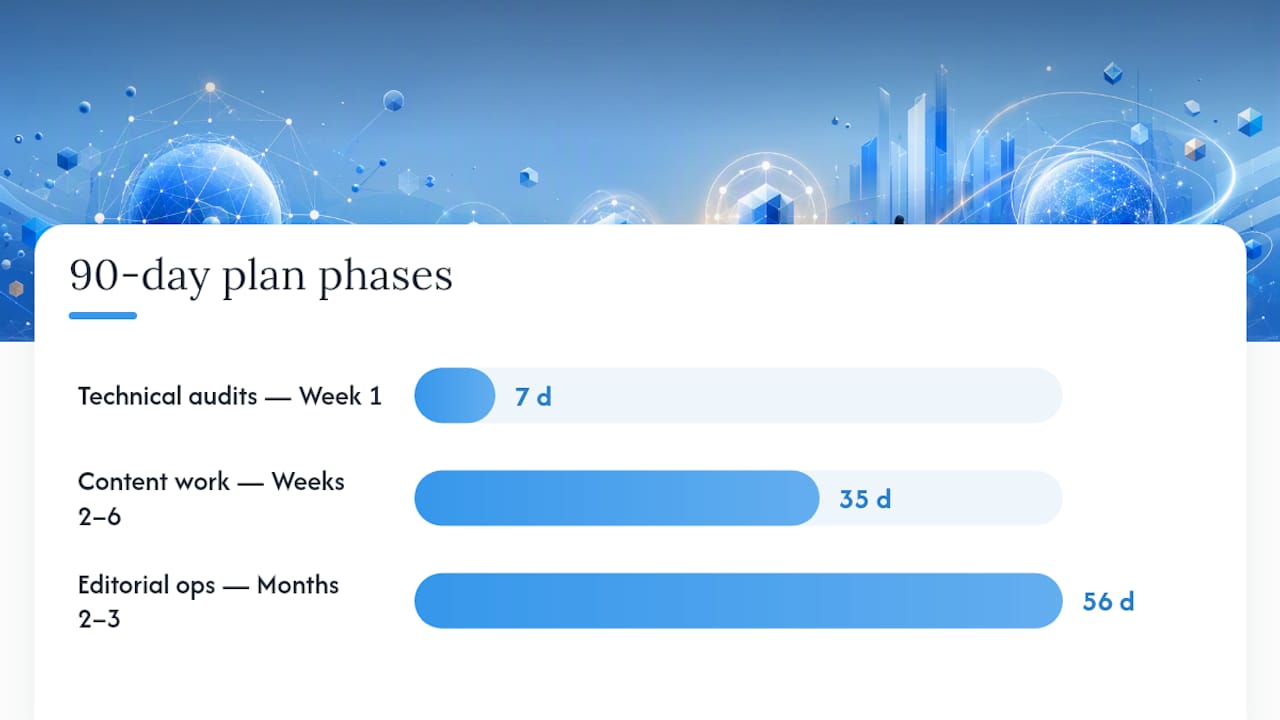
Week 1 is entirely technical: crawlability, indexation, and snippet eligibility audits across your top 10 pages. Weeks 2 through 6 are content: rewriting openings, adding extractable summaries, and restructuring headings around real questions. Months 2 and 3 shift to editorial operations: fixed-prompt monitoring goes live, alerting gets built, and the backlog of targeted fixes starts working through lower-priority pages. Trying to run all three phases at once is how teams end up with a monitoring dashboard full of noise and no fixed baseline to compare it against.
What Does an AI SEO Case Study Actually Look Like?
An agency has applied this exact sequence with clients navigating the shift from ranking-only SEO to combined ranking and citation visibility. The technical and content fundamentals in the checklist above aren’t theoretical; they’re the same groundwork behind measurable commercial outcomes for existing clients.
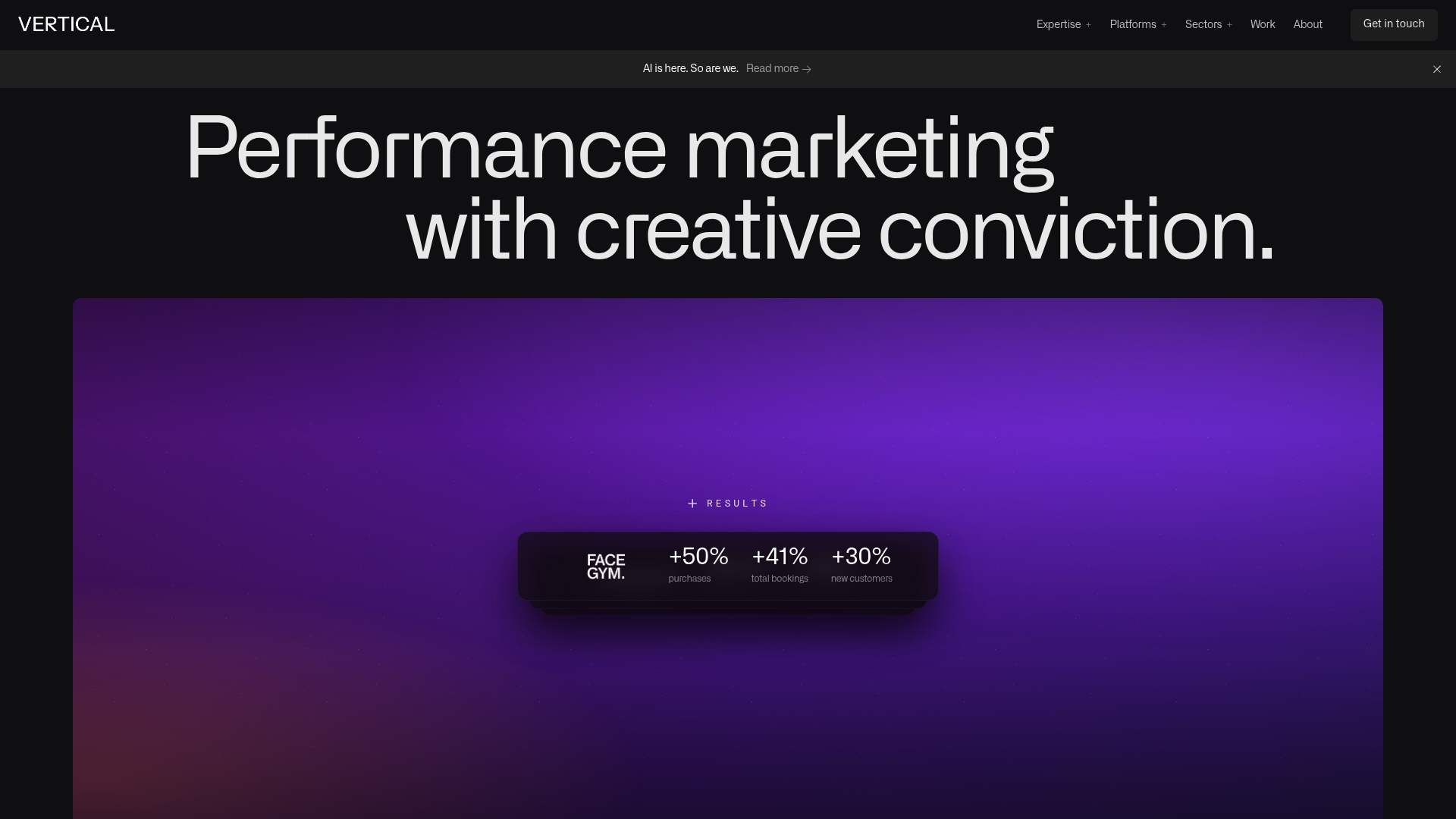
FACEGYM, one such client, saw an increase in purchases and a rise in bookings after Vertical Brands restructured strategy, creative, and performance marketing under one coordinated approach rather than splitting the work across separate vendors. That kind of lift doesn’t come from a single tactic. It comes from technical hygiene, content structure, and measurement working as one system instead of three disconnected efforts reporting to three different account managers.
The checklist items that mattered most in engagements like this:
- Technical audits that caught indexation and crawlability gaps before any content rewrite started, the same sequencing recommended earlier in this guide.
- Content restructured around answer-first openings rather than reworked for keyword density alone.
- Measurement built around a defined baseline before optimization started, so the “before” state was actually documented, not reconstructed after the fact.
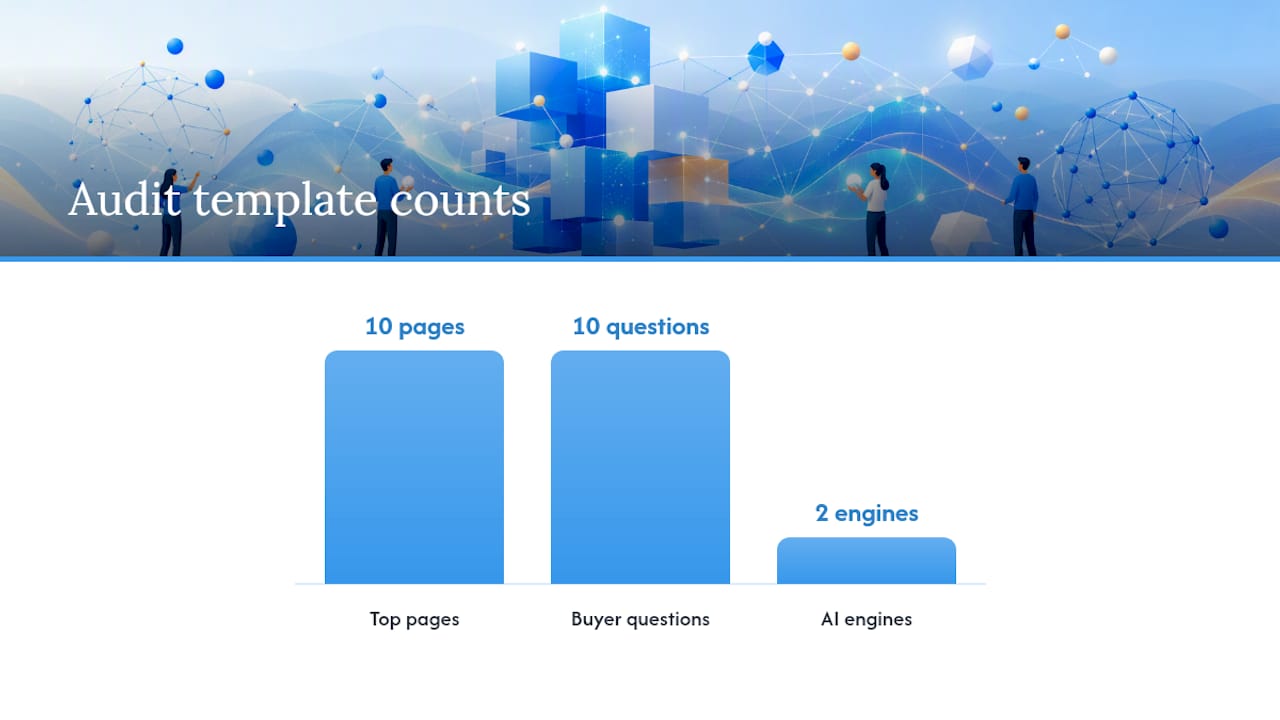
A simple audit template any team can copy: list your top 10 pages by traffic or commercial value, check each for crawlability and snippet eligibility, rewrite the opening paragraph of any page that buries its answer past sentence three, and log a fixed set of 10 buyer questions against at least two AI engines before you touch a single word of content. That sequence alone surfaces most of the quick wins.
What Are the Biggest Myths and Risks in AI SEO?
Google’s own guidance closes the door on several tactics agencies were selling as premium add-ons through 2025. None of them do what vendors claimed.
- llms.txt files do nothing measurable for citation odds; Google’s documentation lists this explicitly as unnecessary.
- Forced content chunking, breaking natural paragraphs into artificial blocks to “help AI parsing,” doesn’t improve extraction and often hurts readability for actual human visitors.
- Special “AI schema” markup beyond standard structured data has no documented effect on generative AI feature eligibility.
The real risks sit elsewhere. Hallucination risk runs in both directions: an AI system can misattribute a claim to your page, and your own AI-assisted drafts can introduce unverified statistics if no one checks them before publishing. Require a sourced link on every statistic, no exceptions, before a draft ships. Over-automation is the quieter risk. A fully automated drafting pipeline with no editorial review produces content that reads as generic enough to get skipped by both AI extraction and human readers, which defeats the entire point. Keep a human editor in the loop on every priority page, and treat AI-assisted drafts as a first pass, not a final one.
How Is AI Changing SEO Career Roles and Required Skills?
The job title “SEO specialist” is stretching to cover work that didn’t exist three years ago, and teams that treat AI visibility as someone else’s problem are already behind. Technical SEO skills (crawl budgets, indexation, structured data) haven’t gone away. They’ve been joined by a new layer: prompt engineering for testing how content performs across AI engines, and data literacy strong enough to read citation logs and spot a real trend versus a one-week blip.
Content roles are shifting too. A writer who understands answer-first structure, extractable summaries, and source-linking discipline is worth more than one who can produce volume alone. Editors increasingly need to evaluate AI-assisted drafts for hallucination risk, not just tone and grammar, which is a genuinely different skill from traditional copyediting.
The clearest shift is in who owns measurement. In a lot of agencies, that used to sit entirely with an analytics specialist checking rank trackers. Now it requires someone fluent in both traditional analytics and the newer, messier discipline of engine-specific citation tracking, often the same person running the fixed prompt set and interpreting Search Console’s generative AI reporting. Teams that cross-train their strategists on this measurement layer, rather than hiring a separate “AI SEO person” in isolation, tend to move faster because the strategist already knows which content decisions caused which citation change.
How Does AI SEO Fit With Paid Search and Social Media?
AI SEO doesn’t operate in a silo, and treating it as a separate line item from the rest of a digital marketing plan wastes the overlap. The same answer-first content structure that improves AI citation odds also improves ad relevance scores in paid search, since both reward clear, specific, well-matched copy over vague positioning.
Social media plays a role too, mostly indirectly. Brand mentions and third-party citations across social platforms and forums increasingly feed into what large language models associate with a brand, which is part of what LLMO tries to influence. A brand with strong, consistent third-party coverage tends to get named more often in generated answers, independent of what’s on its own website.
Paid search and AI visibility monitoring should also share data where possible. If a paid campaign is driving strong click-through on a specific query, that’s a signal the organic and AI-citation strategy should prioritize the same query cluster. Siloed reporting hides this. A unified reporting view, even a simple shared spreadsheet pulling from both channels, catches overlap that separate paid and organic teams routinely miss.
What Are the Limitations of AI SEO, and How Do You Work Around Them?
The biggest limitation is volatility. Citation behavior on any single AI engine can shift week to week with no visible cause, since these systems update their retrieval and ranking logic far more often than Google historically updated core search algorithms. Chasing every fluctuation wastes resources; the fix is trusting the fixed-prompt trend line over any single week’s snapshot.
Attribution is the second limitation. Most AI platforms don’t pass clean referral data the way traditional search does, which makes it hard to tie a citation directly to a conversion. Combining Search Console’s generative AI report with site analytics narrows this gap, but it doesn’t close it fully yet.
Coverage is the third. No monitoring tool covers every AI engine with equal depth, and the market is consolidating fast enough that today’s best per-engine coverage may look thin in a year. Mitigate this by building your fixed prompt set and your logging process independent of any single tool, so switching platforms later doesn’t cost you your historical data.
What’s Next for AI and SEO?
Query fan-out will likely get more sophisticated, meaning content that only answers the literal query text will lose ground to content that anticipates the sub-questions a model generates internally before it answers. Expect briefs to start incorporating those anticipated sub-questions directly.
Multimodal retrieval, where AI systems pull from images, video transcripts, and structured data alongside text, is already emerging in some engines and will expand the definition of “extractable content” well beyond clean paragraphs. Expect more emphasis on well-labeled images and transcribed video content as citable sources.
Per-engine divergence will likely deepen before it consolidates. ChatGPT, Perplexity, and Google AI Overviews already cite differently for the same query, and as each platform tunes its own retrieval logic independently, that gap may widen before any standardization emerges. Teams that built engine-specific measurement now, rather than a single blended score, will be the ones positioned to adapt.
How Should Agencies Package AI SEO Services?
Auditing crawlability and indexation is commodity work at this point. Any competent technical SEO can run that checklist, and clients increasingly know it, so pricing it as a premium deliverable won’t hold up. The strategic value sits in the measurement layer: building the fixed prompt set, interpreting citation volatility correctly, and knowing when a dip is real versus noise.
Package it in three tiers. An initial audit (technical plus a baseline citation check) as a fixed-fee entry point. A pilot, typically 60 to 90 days, applying the content and technical fixes to a handful of priority pages with weekly monitoring. Then ongoing AI visibility operations as a retainer, once the pilot proves the fixed prompt set is catching real signal.
Set expectations early: citation share moves slower than rank position, and clients expecting overnight AI Overview appearances need to hear that in the first call, not the first missed quarter.
— Alex
Ready to Turn AI Visibility Into a Measurable Growth Channel?
Vertical Brands runs the full loop this guide describes under one roof: brand strategy, content and creative execution, technical SEO, and the measurement infrastructure to prove it worked. That’s the specific advantage over piecing together a technical vendor, a content shop, and a separate analytics contractor to cover the same ground, since misaligned hand-offs between three vendors are usually where citation-loss diagnoses stall.
If your team is still measuring success by rank position alone, or you’re not sure whether your top pages would survive an indexation and snippet eligibility check today, that’s the audit to run first. An agency offers both a standalone audit and a 90-day pilot built around the exact prioritization sequence covered above, technical fixes first, content structure second, monitoring third. Start with a conversation about where your priority pages stand right now at Vertical Brands.
Where to Read More on AI SEO
Start with Google’s own generative AI features guide, then Search Engine Land’s AI SEO explainer and Vertical Brands’s technical SEO audit guide for implementation detail.
Sources
- Google Search Central: Optimizing your website for generative AI features on Google Search
- What is AI SEO? How artificial intelligence is changing search optimization — Search Engine Land
- AI Search Engine Optimization: A Practical Guide — GetIntel
- AI content optimization — Semrush blog
Recommended

Other posts


























































Stay ahead with better decisions.
Get business insights today.
